Tropical Weather
The tropics are the areas of the Earth between the Tropic of Cancer (23.5° N) and the Tropic of Capricorn (23.5° S). In this region, the Sun will be directly overhead during some part of the year. The temperature in the tropics does not vary much from season to season because locations receive considerable solar insolation year-round. Weather in the tropics is dominated by convective storms that develop mainly along the Intertropical Convergence Zone (ITCZ), the Subtropical High Pressure Zone, and oceanic disturbances in the trade winds that sometimes develop into hurricanes.
One of the most important weather features found in the tropics is the Intertropical Convergence Zone (ITCZ). The ITCZ is characterized by a broad band of cumulus and cumulonimbus clouds, produced by dynamic atmospheric lifting driven by convergence and convection. In general, the ITCZ delineates the location where the noonday Sun is directly overhead on the globe. Because of the high Sun, the ITCZ receives the greatest quantity of daily solar insolation in the tropics. At the ITCZ, this energy evaporates large amounts of water, converting it into sensible heat at the ground surface and in the atmosphere. Often, these processes lead to the near-daily development of convective thunderstorms by providing moisture and heat to developing cumulonimbus clouds. The ITCZ also marks the convergence of the northeast and southeast trade winds. The convergence of these wind systems enhances the development of convective rain clouds in the tropics.
The ITCZ moves seasonally with the tilt of the Earth's axis. The convective rains accompanying the ITCZ passage are an important precipitation source for locations roughly 10 to 23.5° N and S latitude. Figure 8.30 describes the seasonal movement of the ITCZ and other systems associated with our planet's global circulation.
The other important weather feature in the tropics is the Subtropical High Pressure Zone. Airflow in the Subtropical High Pressure Zone is primarily descending. This situation creates clear skies, low humidity, and hot daytime temperatures. Like the ITCZ, the Subtropical High Pressure Zone migrates seasonally (see Figure 8.30). It generally influences latitudes 10 ° to 23.5° N and S at some point during the year.
Easterly Waves
Weather disturbances in the trade winds, known as easterly waves, are another source of cloud development and precipitation in the tropics. Easterly waves develop first as a weak disturbance in the atmosphere, usually because of the presence of localized warmer ocean temperatures. On a weather map, these weather systems appear as a wave in the isobars (Figure 8.31). On the eastern side of this wave, convergence occurs, forming numerous thunderstorms (divergence occurs on the western side). This weather feature is known as atropical disturbance. The storm system may intensify and organize into ahurricaneif the convergence is strong enough. On average, about 10% of the tropical disturbances associated with easterly waves develop into hurricanes.
Hurricanes
Hurricanes are intense cyclonic storms that develop over the warm oceans of the tropics (Figure 8.32). These tropical storms go by other names in various parts of the world: India/Australia -cyclones; western North Pacific -typhoons; and the Philippines -baguio. By international agreement, the term tropical cyclone is used by most nations to describe hurricane-like storms that originate over warm tropical oceans. Surface atmospheric pressure in the center of a hurricane tends to be extremely low. The lowest pressure reading ever recorded for a hurricane is 870 mb - typhoon Tip, 1979. However, most storms have an average pressure of 950 mb. To be classified as a hurricane, sustained wind speeds must be greater than 119 kph (74 mph) at the storm's center. Wind speed in a hurricane is directly related to the surface pressure of the storm. The following graph (Figure 8.33) shows the relationship between surface pressure and sustained wind speed for many tropical cyclone systems.
Hurricanes have no fronts associated with them like the mid-latitude cyclones of the polar front. They are also smaller than the mid-latitude cyclone, measuring 550 km (340 mi) in diameter on average. Mature hurricanes usually develop a cloud-free eye at their center (Figure 8.34). In the eye, air is descending, creating clear skies. The eye of the hurricane may be 20 to 50 km (12 to 31 mi) in diameter. Surrounding the eye are bands of organized thunderstorm clouds formed as warm air moves in and up into the storm (Figure 8.35). The strongest winds and heaviest precipitation are found in the area next to the eye, where a vertical wall of thunderstorm clouds develops from the Earth's surface to the top of the troposphere.
Hurricane Development, Movement, and Dissipation
Hurricanes are powered by the latent heat energy released from condensation. To form and develop, they must be supplied with a constant stream of warm, humid air. Surface air with enough energy to generate a hurricane only exists over oceans with temperatures above 26.5°C (80°F). Further, this warm surface water must be in a layer at least 200 m (660 ft) deep. Ocean temperatures this high occur only in specific regions of our planet and during particular seasons. Hurricane development can also be prevented by the presence of a temperature inversion in the atmosphere. Inversions develop in the tropics when subtropical high-pressure systems produce sinking air.
Hurricanes go through several different stages of development. Initially, these powerful storms begin their lives as a group of unorganized thunderstorms that develop over specific areas of the tropical oceans. However, not all of these types of tropical disturbances become hurricanes. Cyclonic circulation must develop around tropical disturbances for them to form into a hurricane. This type of circulation enhances the growth of the thunderstorm cluster by providing additional moisture and latent heat energy. With more moisture and latent heat energy, the strength and number of thunderstorms in the tropical disturbance increase, intensifying the disturbance. The thunderstorms also begin to organize themselves into spiral bands that swirl cyclonically toward the storm's center. If the sustained wind speed around the disturbance increases to between 37 and 63 kph (23 and 39 mph), the storm becomes classified as atropical depression. Tropical depressions appear on the weather map as a cyclonic low with several closed isobars circling the storm's center. A tropical depression can continue to intensify and become a tropical storm, the next stage in hurricane development.Tropical stormshave lower central pressure, more closed isobars on a weather map, and winds between 64 and 118 kph (40 to 73 mph). Finally, tropical storms officially become hurricanes when their sustained wind speed exceeds 119 kph (74 mph).
Figure 8.36 shows the tropical and subtropical ocean areas where hurricanes typically form on our planet. These areas generally extend poleward to a maximum latitude of about 25 to 30° North or South. The exclusion of hurricanes from around the equator is related to the Coriolis force being almost negligible here. A specific threshold quantity of Coriolis force is required to initiate cyclonic flow. Note that hurricanes do not form over the Southeastern Pacific Ocean, the South Atlantic Ocean, or off the coast of Northern Africa. In these regions, cool ocean temperatures or temperature inversions can restrict formation.
Hurricanes are seldom motionless after their initial formation. Typical directions of movement are displayed in Figure 8.37 for the various ocean basins that generate hurricanes. The patterns shown in this map are highly generalized. On average, hurricanes that form in the North Atlantic and North Pacific move westward or northwestward. In reality, the track taken by any individual storm is often very chaotic. Hurricanes can suddenly change both their speed and direction of travel.
Figure 8.38 describes the annual number of hurricanes that developed in the North Atlantic, Northeast Pacific, and Northwest Pacific ocean basins from 1951 to 2014. Of these three regions, the Northwest Pacific Ocean basin produced the most hurricanes for this period, an average of 17.0 storms per year (Figure 8.38). The mainland of North America is often influenced by storms in the North Atlantic and Northeast Pacific, producing a yearly average of 6.0 and 7.6 hurricanes, respectively. Most storms in the Northeast Pacific travel away from North America out to the open ocean (see Figure 8.37).
Tropical storms and hurricanes also have very specific seasonal patterns. The peak season for these weather events in the Southern Hemisphere is January to March. Most tropical storms and hurricanes in the Northern Hemisphere develop from June to November. Figure 8.39 describes the monthly frequency of storm formation in the three ocean basins found in the Northern Hemisphere from 1950 to 2000. Each basin has slightly different patterns. Tropical storms and hurricanes rarely form in the North Atlantic and Northeast Pacific basins from December to April. The Northwest Pacific basin has a significant number of storms forming throughout the year.
Hurricanes dissipate when the availability of latent heat energy is substantially reduced. This situation occurs either with landfall or storm movement into cooler seas. Most hurricanes live for about a week. If a hurricane can remain over warm water, its life can be extended. In 1992, Hurricane Tina was an active tropical storm for 24 days over the North Pacific.
Hurricane Classification
The most commonly used system to classify the strength of hurricanes is theSaffir-Simpson Scale (Table 8.5). This classification scheme was developed so the public could quickly estimate the potential damage that a hurricane’s winds and storm surge could cause in a coastal area. The first two categories describe the two stages before a storm becomes a hurricane: TD - tropical depression and TS - tropical storm. Hurricanes are categorized into five intensity scales ranging from 1 to 5. A major hurricane is classified as three or above.
Figure 8.40 describes the number of category 1 to 5 hurricanes that developed in the North Atlantic, Northeast Pacific, and Northwest Pacific ocean basins from 1951 to 2014. Note that the Northwest Pacific basin produces proportionally more major hurricanes (category 3, 4, and 5) than the other two basins.
Hurricane Damage and Destruction
Tropical cyclones are the deadliest and most destructive severe weather events on our planet. One of the most catastrophic hurricanes in the last 100 years was the Bhola Cyclone (category 3), which made landfall on the coast of Bangladesh on November 12, 1970. This storm had a minimal pressure reading of 966 millibars and maximum sustained winds of about 185 km/hr. Estimates suggest that over 300,000 people died from this storm. Most of these deaths were caused by flooding from storm surge and heavy rain. The high death toll caused by this hurricane was due to a lack of preparedness. It is believed that less than 1% of the population took shelter in fortified buildings. One of the deadliest Atlantic storms is Hurricane Mitch (category 5). Hurricane Mitch made landfall in populated areas of Central America twice: in late October and early November 1998. Estimates suggest that over 11,000 people died from this storm. Most of these deaths were caused by flooding and mudslides due to heavy rains.
High wind speeds, heavy rainfall, storm surge, and tornadoes cause the damage that hurricanes inflict.Storm surgeis an increase in the height of the ocean's surface in the region beneath and around the eye of the storm. Storm surge occurs when low atmospheric pressure causes the ocean surface to expand, and because the hurricane's cyclonic winds blow seawater towards the eye. Wind speed in a hurricane is usually directly related to atmospheric pressure (see Figure 8.33). The lower the pressure, the faster the winds blow. Wind speed also varies within the storm. As discussed earlier, winds are usually strongest at the edge of the hurricane's eye. High winds inflict damage by flying debris, blowing down objects, creating choppy waves and high seas, and inundating coastal areas with seawater. Rainfall within a hurricane often exceeds 60 cm (24 in) in 24 hours. If this rainfall occurs on land, flooding often results. Hurricane Camille (1969 – category 5) had a storm surge of more than 7 m (23 ft) with a central pressure of 909 mb. A considerable amount of damage can also occur because of tornadoes. About 25% of the hurricanes that make landfall have associated tornadoes. There is evidence that thunderstorms near the eye of a hurricane can produce very strong downbursts (vertical downward air movements).
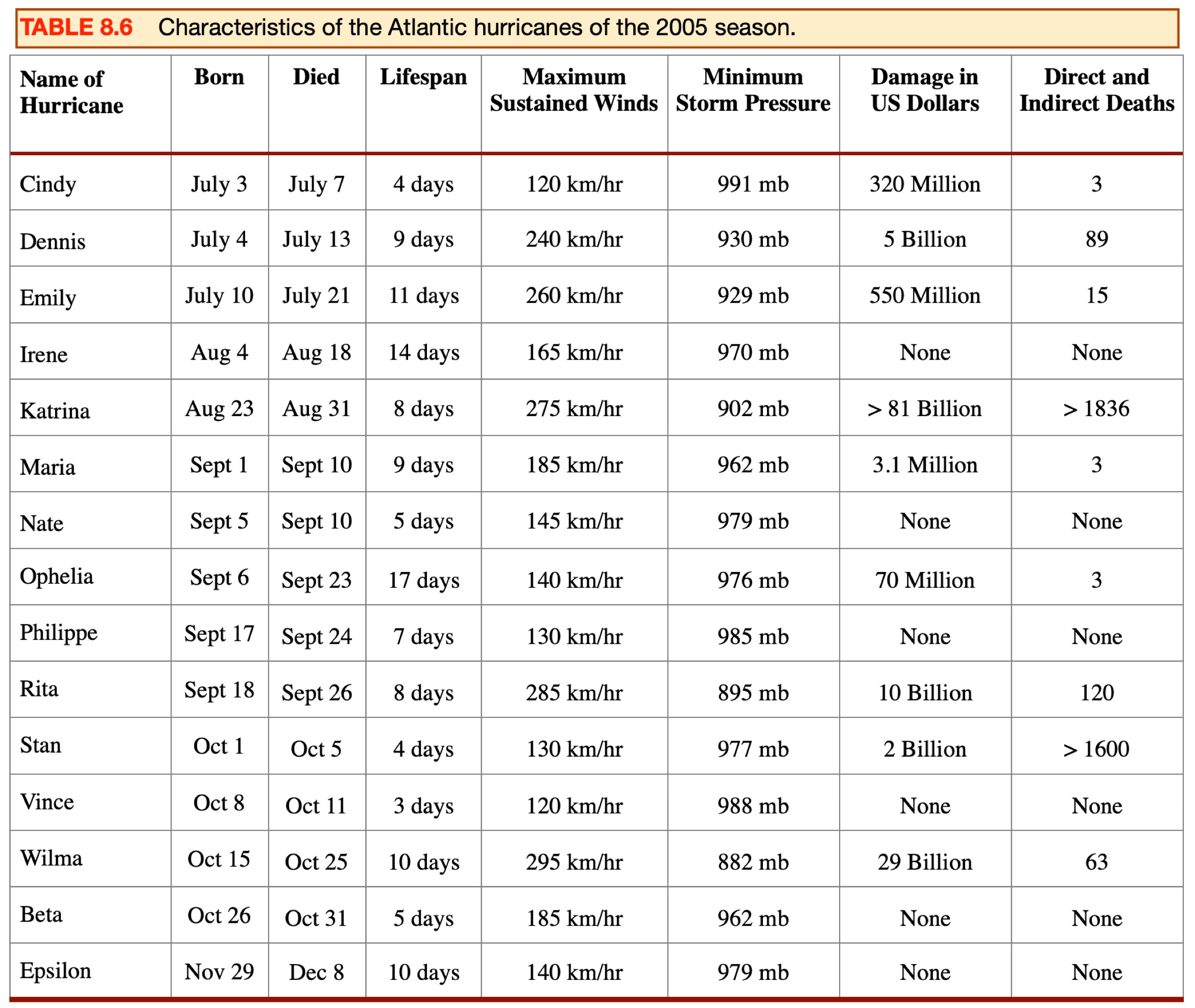
The year 2005 was particularly active for tropical storms and hurricanes in the Atlantic Ocean. During that year's late summer and fall, 28 tropical storms developed, of which 15 became hurricanes. Table 8.6 describes some of the characteristics of each storm that developed into hurricanes. Seven tropical storms and hurricanes made landfall in the United States, causing more than $100 billion in damage. Hurricane Katrina was the most destructive storm of 2005, causing over $81 billion in damage. This hurricane made landfall at the mouth of the Mississippi River on August 29th and flooded 80% of New Orleans (Figure 8.41). The strongest hurricane of the 2005 season was Hurricane Wilma with a minimum storm pressure of 882 mb. This pressure reading is the lowest ever recorded for the Atlantic Ocean in modern times.
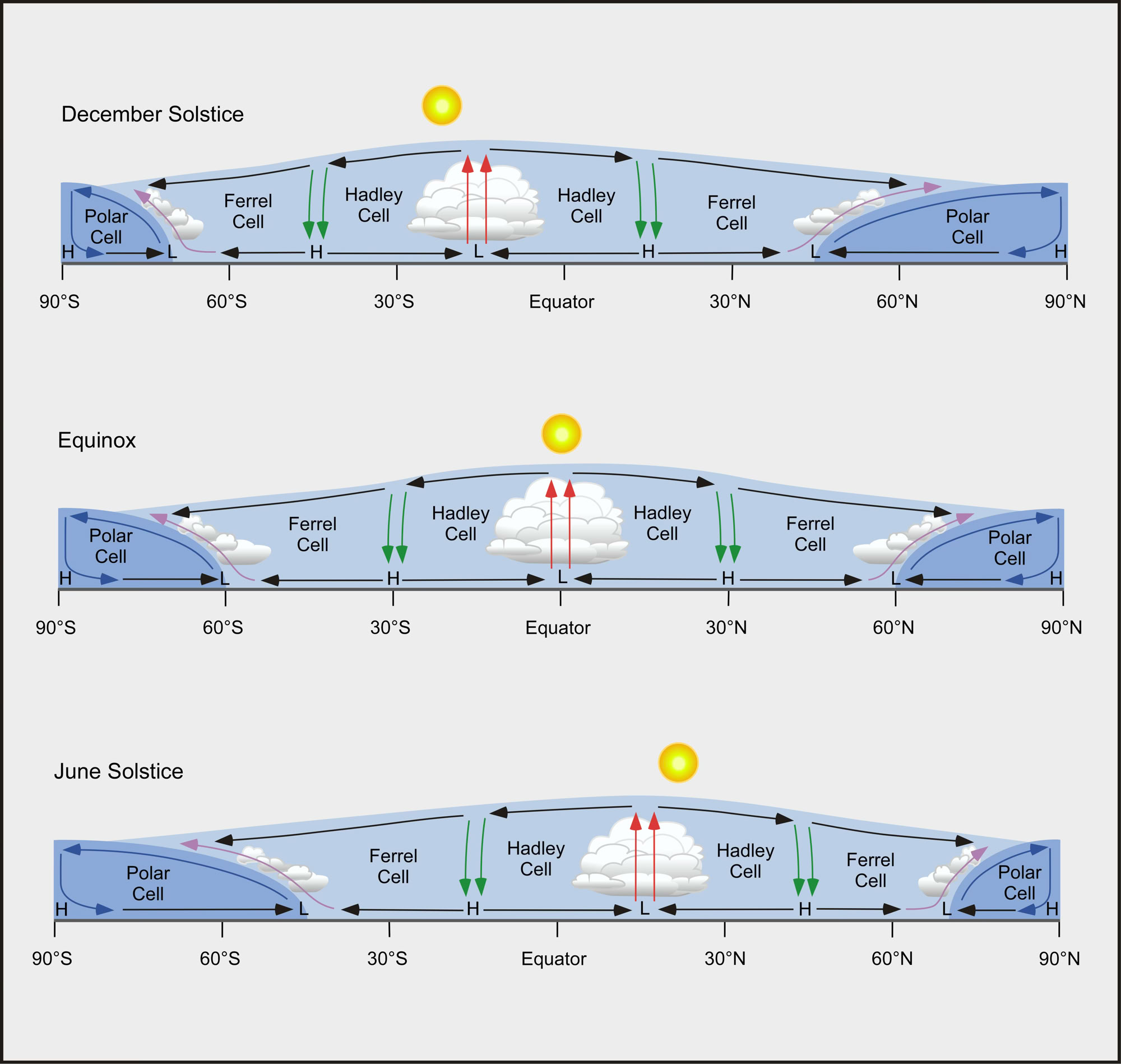
FIGURE 8.30 Seasonal movement of the Earth's global circulation patterns. The principal circulation cells are identified in the Equinox figure. In the Equinox figure, the Intertropical Convergence Zone (ITCZ) occurs at the equator where the Trade Winds converge, creating a low-pressure center and updrafts (red arrows). The upward movement of moist tropical air above the Intertropical Convergence Zone produces a band of thunderstorms that brings precipitation to the tropics. At the zone where the Hadley Cell and Ferrel Cell meet, tropospheric airflow is downward, moving from the top of the troposphere to the Earth's surface (green arrows). These downdrafts create the Subtropical High Pressure Zone on the Earth's surface. Surface air also moves upward into the troposphere at the boundary between the Ferrel Cell and the Polar Cell. At this location, frontal lifting associated with mid-latitude cyclones moves warm subtropical air over cold polar air, producing clouds and precipitation. Note how the Earth's circulation patterns change their position in the December and June Solstice figures. Image Copyright: Michael Pidwirny.

FIGURE 8.31 Most tropical storms develop from a weather feature known as an easterly wave. On weather maps, these features appear as a “wave” in the isobars that travels from east to west. Normally, many thunderstorms form on the east side of the easterly wave because of convergence. If this mass of thunderstorms causes cyclonic airflow, the development of a hurricane often follows. Image Copyright: Michael Pidwirny.

FIGURE 8.32 Displayed above are satellite images of four different storm systems. Note how all of these storms are very similar in appearance. A. Hurricane Mitch, October 26, 1998, B. Hurricane Linda, September 12, 1997, C. Hurricane Andrew, August 25, 1992, and D. Hurricane Nora, September 22, 1997. Image Source: NASA.

FIGURE 8.33 Relationship between surface pressure and wind speed for a number of tropical low-pressure systems. Tropical low-pressure systems are classified as hurricanes when their pressure is 980 millibars or lower and their sustained wind speeds exceed 118 kilometers per hour (73 mph). Image Copyright: Michael Pidwirny.

FIGURE 8.34 Satellite view of Hurricane Floyd making landfall in North Carolina, September 15, 1999. Notice that the eye is clearly visible in this image. Image Source: NASA.

FIGURE 8.35 Graphical model showing a vertical cross-section of the air circulation, clouds, and precipitation associated with a hurricane. Image Copyright: Michael Pidwirny.

FIGURE 8.36 Locations where hurricanes begin their development. The data for this map is from 1950 to 2000. Image Copyright: Michael Pidwirny.

FIGURE 8.37 Common paths of hurricane movement. Image Copyright: Michael Pidwirny.

FIGURE 8.38 Yearly hurricane numbers for the North Atlantic, Northeast Pacific, and Northwest Pacific ocean basins from 1951 to 2014. The average number of hurricanes for each ocean basin is displayed in red. Image Copyright: Michael Pidwirny.
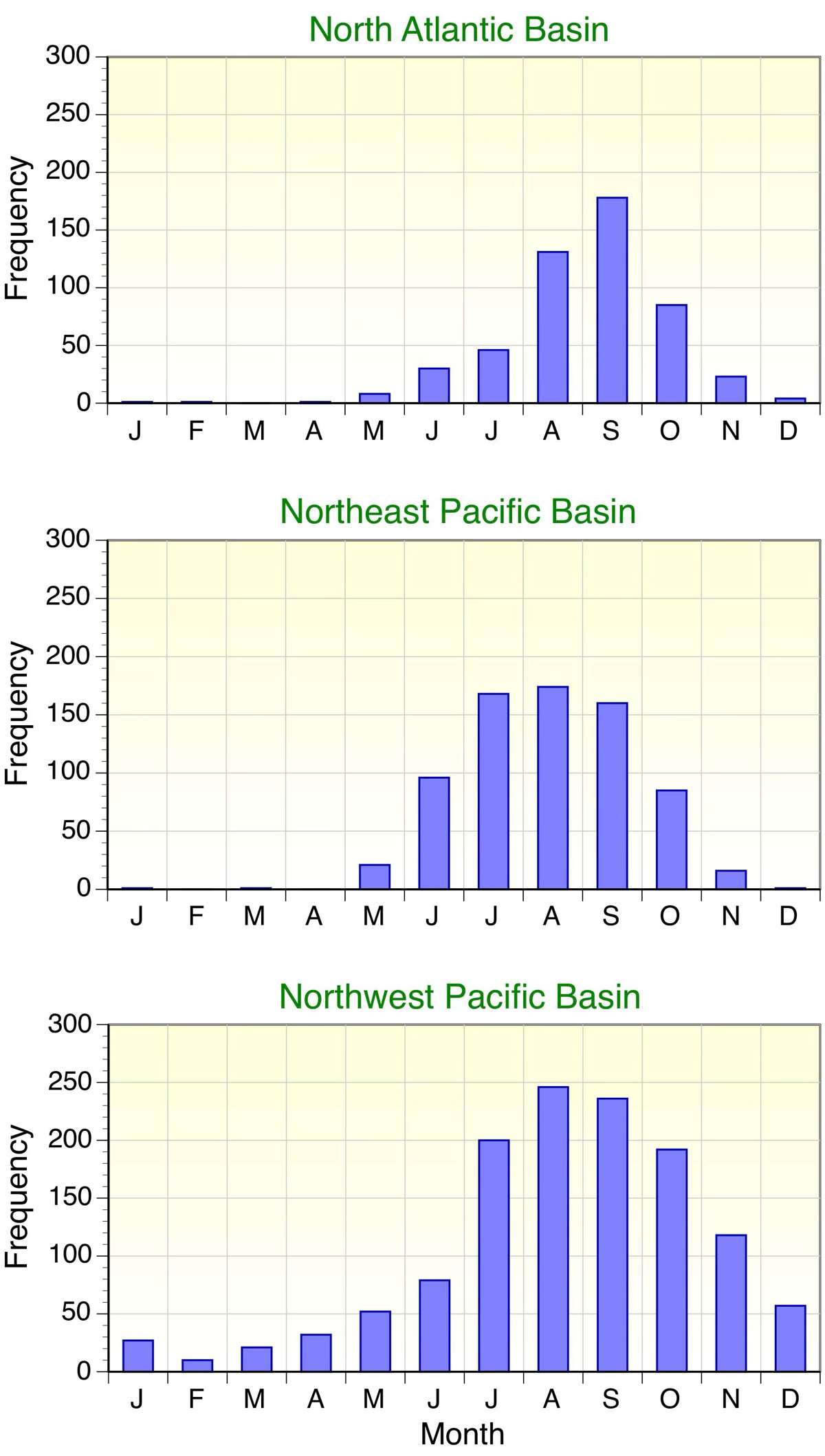
FIGURE 8.39 Yearly hurricane numbers for the North Atlantic, Northeast Pacific, and Northwest Pacific ocean basins from 1951 to 2014. The average number of hurricanes for each ocean basin is displayed in red. Image Copyright: Michael Pidwirny.
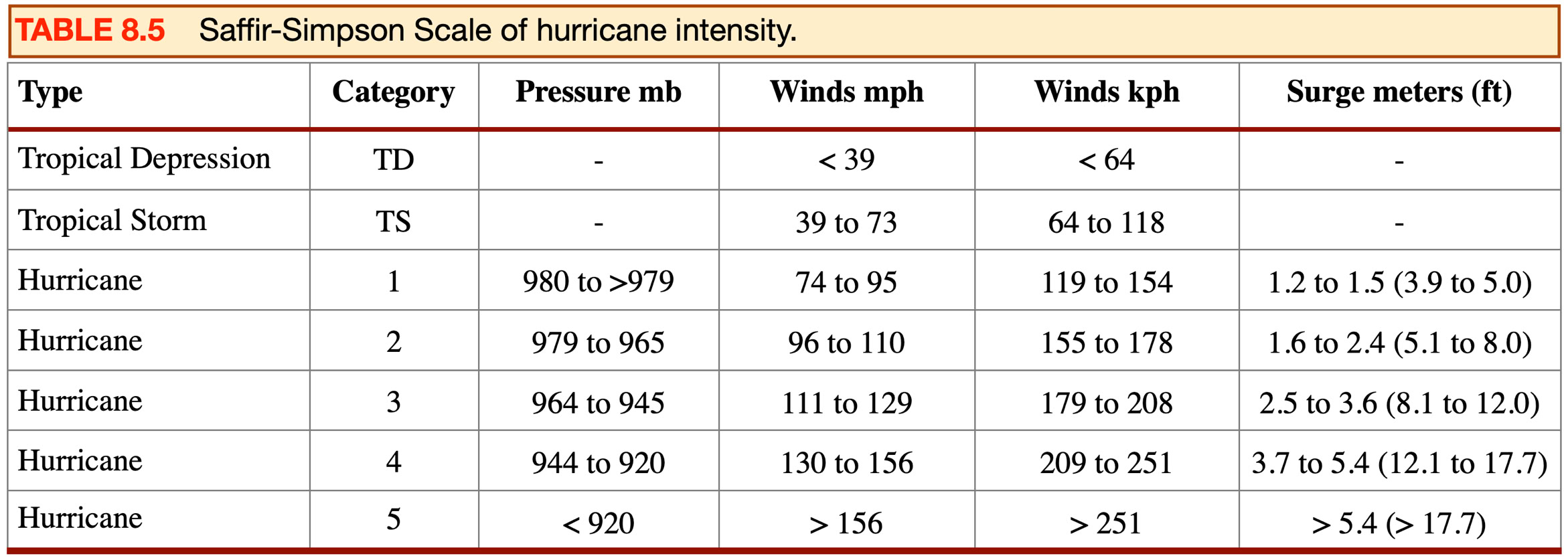

FIGURE 8.39 Combined tropical storm and hurricane monthly frequency for the North Atlantic, Northeast Pacific, and Northwest Pacific ocean basins. Data is for the period 1950 to 2000. Image Copyright: Michael Pidwirny.