This website’s primary goal is to describe how Earth Science is the scientific study of planet Earth. To achieve this goal, we must also gain an understanding of phenomena that occur outside Earth's atmosphere in the void of space. This knowledge will help explain how the Earth formed and allow us to compare Earth's characteristics with those of the other planets in our solar system. We will also learn that our planet and solar system are a very insignificant part of the Universe in terms of spatial scale. Yet, as far as we know, the Earth is the only place in the Universe that is home to life. So how did the Universe begin, and what are some of its major structures? A theory is presented next to describe the origin of the Universe.
The Big Bang Theory
About 13.8 billion years ago, all the matter and energy in the Universe was concentrated into an area the size of an atom. At this instant, matter, energy, space, and time did not exist. Then suddenly, the Universe began to expand at an incredible rate, and matter, energy, space, and time came into being. This event has been called the Big Bang.
By about 10-11 seconds after the start of the Big Bang, the four fundamental forces of the Universe were in existence: the strong nuclear force (responsible for holding the nuclei of atoms together), the electromagnetic force (which controls electric and magnetic effects), the weak nuclear force (the cause of radioactive decay), and the gravitational force. The temperature of the Universe at this moment is estimated to be one quadrillion (1015) Kelvin. At about 3 to 20 minutes after the start of the expansion, the temperature of the Universe drops to about one billion (109) Kelvin, and the unstable atomic nuclei of the simple elements of hydrogen, helium, and lithium start to form as protons and neutrons combine through nuclear fusion. Stable atoms of matter began to form between 500,000 and one billion years after the Big Bang. As the Universe continues to expand, the temperature of the cosmos continues to decline. Matter begins to coalesce into gas clouds, then into stars and planets. Our solar system formed about 5 billion years ago when the Universe was about 65% of its present size. Today, the Universe continues to expand outward, and the average temperature of the cosmos is about 2.726 Kelvin.
The scientific community's acceptance of this theory is based on several observations. These facts confirm specific scientific predictions of the Big Bang theory. In a previous chapter, we learned that scientists test their theories through deduction, falsification, and predictions. Important predictions associated with the Big Bang theory that have been tested scientifically are:
- If the Big Bang did occur, all the objects within the Universe should be moving away from each other. In 1929, Edwin Hubble documented that the galaxies in our Universe are indeed moving away from each other (Hubble, 1929).
- The Big Bang should have left an afterglow. In the 1960s, scientists discovered cosmic radiation, the background afterglow created by the Big Bang (Penzias and Wilson, 1965). Our most accurate measurements of this cosmic radiation were obtained in November 1989 by the Cosmic Background Explorer (COBE) satellite. Measurements from this satellite tested a critical prediction of the Big Bang theory: that the initial explosion that gave birth to the Universe should have created radiation with a spectrum that follows a blackbody curve. The COBE measurements indicated that the cosmic radiation spectrum followed a blackbody curve (Smoot et al., 1992).
- If the Universe began with a Big Bang, extreme temperatures should have caused 25% of the Universe's mass to become helium (Harrison, 2022). This situation is precisely what is observed.
- Matter in the Universe should be distributed homogeneously. Astronomical observations from the Hubble Space Telescope indicate that matter in the Universe is generally distributed homogeneously.
Modern cosmologists have postulated three possible endings to the Universe (Harrison, 2022). If the Universe is infinite or has no edge, it could continue to expand forever. The Universe could also expand at a rate that gradually slows with time. When the expansion rate becomes zero, the Universe will stop growing and reach its maximum size. The final scenario suggests that if the Universe is finite or closed, gravity will cause it to collapse once expansion stops. This collapse would end when all matter and energy are compressed back into the high-energy, high-density state from which the Universe began. This end event is suitably called the Big Crunch. Some theorists have suggested that the Big Crunch will produce a new Big Bang, and an expanding Universe will begin again. This idea is called the Oscillating Universe Theory (Tolman, 1934).
Structure of the Universe
Our knowledge of the structure of the Universe is based on data from various instruments aboard satellites (Figure 3.1) and observations from optical and radio telescopes located on the Earth's surface (Figure 3.2). Through these instruments, we have discovered many unique celestial objects. The existence of some of these things ended a very long time ago. We still see them today because they are incredibly distant from our planet. It is very hard to imagine how far some of these distances are. But consider the speed of light is 9.46 trillion km per year (one light-year) and the fact that it took light from these objects billions of years to reach us! In comparison, light from the Sun takes about 8 minutes to reach the Earth over a distance of approximately 149.5 million km (92.9 million mi).
Astronomers estimate that the diameter of the Universe is at least 93 billion light-years. In this large area, gravity has caused matter to concentrate, forming various celestial bodies at random. The most obvious of these are the luminousstarswe see in our sky at night. Stars are formed when massive concentrations of once interstellar hydrogen gas collapse inward because of gravity. Stars generate light energy through nuclear reactions that cause hydrogen nuclei to fuse into helium nuclei at their core. These nuclear fusion reactions occur because the star's enormous mass creates a gravitational force strong enough to cause atoms to bind together. A star'snuclear fusionreactions also produce an interior temperature greater than 15 million °C (27 million °F). The migration of this heat energy to the star's surface then produces electromagnetic radiation (starlight) that radiates outwards into space.
Stars are often organized in much larger celestial bodies known as galaxies (Figure 3.3). We can find billions of stars and immense concentrations of interstellar gas and dust within a galaxy. The Milky Way Galaxy, home to our Sun, is believed to contain over 200 billion stars and has a diameter of about 100,000 light-years. The Milky Way is also a member of a collection of three large and over 30 smaller galaxies. This galaxy group measures about three million light-years in diameter, and astronomers call it the local group. Galaxy groups, like our Local Group, are common and often belong to even larger structures in the Universe. These structures consist of many galaxy clusters to form a supercluster. These celestial objects are the largest features in our Universe and can measure about 100 million light-years in diameter.
A typical galaxy consists of three parts: the disk, the nuclear bulge, and the halo (Figure 3.4). The disk consists of all the matter distributed along a plane of rotation. This includes young stars, clusters of stars, and most of the galaxy’s gas and dust. The matter found in the disk is often organized into several spiral arms. The presence of these spiral arms indicates that the disk is moving. The nuclear bulge is located at the heart of the galaxy. This almost-spherical feature is composed of a dense concentration of young and old stars. Observations of the nuclear bulge suggest that it lacks gas and dust. The halo is a thin cloud of stars and star clusters (called globular clusters) that surrounds the disk and nuclear bulge. It also contains very little gas, and as a result, relatively few stars exist here.
The Solar System
Stars often have many objects orbiting around them in an adjacent region of space known as a solar system. Our solar system formed about 4.6 billion years ago and consists of the Sun, eight planets, at least three dwarf planets, about 130 satellites, and many comets and asteroids. A planet can be defined according to the following criteria: 1) It is a celestial body that orbits a star, 2) it has cleared the space along its orbital path of objects, 3) its self-gravitational force has shaped its surface to be nearly spherical, and 4) it does not have the ability to generate its own light. The definition of a dwarf planet meets all the criteria of a planet, except that it has not cleared the space along its orbital path of objects. Satellites are bodies that orbit around planets and dwarf planets. The Earth's moon is considered to be a satellite. An asteroid is a small, rocky, planet-like object that orbits the Sun. Several tens of thousands of these objects are in a dense band between Mars and Jupiter. A comet is a small body of ice and dust that orbits the Sun. The orbit of comets tends to be very elongated and elliptical. The ice vaporizes when these objects approach the Sun, producing a breathtaking glowing tail.
The orbits of most of our solar system's planets are almost circular ellipses. Mercury and Pluto are the exceptions; their orbits are more oval-shaped. The orbits of the planets are also approximately at the same ecliptic plane. This ecliptic plane is tilted an average of about 7° from the plane of the Sun's equator. Pluto's orbit tilts with an inclination of 17°. Some other characteristics of the planets in our solar system are described in Table 3.1.
The Inner Solar System
Astronomers usually divide the solar system into two parts: the inner and outer solar system. The inner solar system contains the planets Mercury, Venus, Earth, and Mars (Figure 3.5). Of this group of planets, Mercury is the closest to the Sun (Figure 3.6). The distance of Mercury from the Sun varies between 46 and 70 million km or between 28.6 and 43.5 million mi (average of about 57.9 million km or 36.0 million mi). Surface temperatures on Mercury vary from -200°C (-328°F) to 430°C (806°F). This extreme temperature range is due to its proximity to the Sun and its relatively slow rotation (about 59 days to complete one cycle). When Mercury is turned away from the Sun, its surface experiences a significant drop in temperature because it does not receive sunlight for an extended period. No other planet in our solar system has as great a diurnal temperature variation, and only Venus is hotter. Mercury has a very thin atmosphere composed mainly of sodium, potassium, and helium. Mercury's surface is heavily cratered from meteorites. It is also very old and has no tectonic system to renew the surface crust.
Venus is the second planet from the Sun, with an average orbital distance of 108.2 million km (67.2 million mi) (Figure 3.7). The size and mass of this planet are very similar to those of Earth. However, the other characteristics of Venus are quite different from those of our world. For example, Venus' rotation is very slow (243 Earth days), and the direction of movement when viewed from the North Pole is clockwise (Earth's rotation is counterclockwise when viewed from the North Pole). The atmosphere of Venus is composed mainly of carbon dioxide and is about 90 times denser than Earth's air. The carbon dioxide-rich atmosphere creates an extreme greenhouse effect that results in surface temperatures of around 467°C (873°F), which is hot enough to melt lead. Venus' atmosphere also contains several cloud layers that are several kilometers thick and composed of sulfuric acid. Radar images from the Magellan satellite indicate that a wide variety of interesting and unique landform features exist on the surface of Venus. One mountain, Maxwell Montes, reaches an altitude of 12 km (7.5 mi). For comparison, Mt. Everest is 8.8 km (5.5 mi) high. Planetary geologists speculate that the oldest terrains on Venus are only about 800 million years old. Extensive volcanism at that time is believed to have destroyed the earlier surface, leaving many relatively young volcanic landforms.
Our home, Earth, is the third planet from the Sun. What makes Earth so interesting is that it supports life. As far as we know, no other world in our solar system has a biosphere. The development of a biosphere can only occur with the right mixture of planetary characteristics. For example, Earth's atmosphere contains enough oxygen and carbon dioxide to allow for plant photosynthesis and plant and animal cellular respiration. The particular orbital and rotational characteristics of the Earth help to maintain a range of surface temperatures that encourage the existence of organisms. Lastly, Earth's unique size and mass produce a gravitational force neither too strong nor too weak for life. A stronger gravitational force would crush living cells and prevent organisms from developing vertical body shapes. A weaker gravitational force would have never caused important gases needed by life to accumulate in the atmosphere. While the Earth is unique in our solar system because of its life, scientists have estimated that the Milky Way Galaxy might contain about 9 billion Earth-like planets (Petigura et al., 2013).
The last planet in the inner solar system is Mars (Figure 3.8) with an average distance from the Sun of 227.9 million km (141.6 million mi). Mars has especially fascinated scientists because, when observed with an Earth-based telescope, it often reveals surface features that appear like artificial water channels. For many years, astronomers were convinced that these features could have only been produced by intelligent life. Better observation technologies in the second half of the 20th century suggested that these features had been misidentified. Further, several space missions that landed scientific instruments on the surface of Mars in 1976 and 1997 failed to find conclusive evidence for even microscopic life. However, in 1996, David McKay and his research colleagues announced in the highly regarded journal Science the discovery of organic compounds in a Martian meteorite (McKay et al., 1996). These scientists further theorized that these compounds, in combination with several other mineralogical features observed in the meteorite, may be evidence of ancient Martian microorganisms!
During its orbit, Mars' distance from the Sun varies by about 42.6 million km (26.5 million mi). This significant change in solar distance causes the Martian average surface temperature to vary by about 30°C (54°F) near the equator annually. In comparison, annual average surface temperatures at Earth's equator vary by no more than 5°C (9°F). Across the Martian globe, surface temperatures range from a chilling -133°C (-207°F) at the winter pole under conditions of complete darkness to almost 27°C (81°F) near the equator during summer. Mars has a very thin atmosphere composed primarily of carbon dioxide (95.3%), nitrogen (2.7%), argon (1.6%), oxygen (0.15%), and traces of water (0.03%). The average atmospheric pressure on the surface of Mars is 0.7% of Earth's. Mars has a fascinating landscape. Satellite images have revealed evidence of water erosion in many areas of Mars. Such surface features suggest that flowing water once occurred. Mars is also home to the solar system's tallest mountain. Volcanic Olympus Mons rises 27 km (16.8 mi) above its surrounding plain. Mars has two tiny moons that orbit relatively close to its surface.
The Outer Solar System
The outer solar system contains the dwarf planet Pluto and the planets Jupiter, Saturn, Uranus, and Neptune (Figure 3.9). Jupiter, Saturn, Uranus, and Neptune are quite different from the planets we have already discussed. All these planets are quite large, and their total mass accounts for more than 99% of the matter in our solar system (excluding the Sun). Also, these four planets do not have solid surfaces. Instead, their masses are mainly composed of hydrogen and helium gas that becomes increasingly dense as you travel from the edge of their atmosphere towards the planet’s interior.
Jupiter is the largest planet in our solar system (Figure 3.10). This gas giant has a volume approximately 1,000 times that of Earth (one-tenth the diameter of the Sun). The planet's cloud surface temperatures are about -121°C (-186°F). Jupiter radiates more energy into space than it receives from the Sun because the planet's interior is quite hot. Scientists estimate that the core has a temperature of about 20,000°C (36,000°F). The planet's gravitational compression generates this heat. Most researchers believe Jupiter may have a relatively small, solid rocky core with a mass of 10 to 15 Earths. Above this solid core is a layer of liquid metallic hydrogen (hydrogen with ionized protons and electrons). This unique form of hydrogen can only exist under extreme pressure and temperature conditions. Such conditions occur only in the deep interiors of Jupiter and Saturn. On top of the liquid metal hydrogen layer is the outermost zone, composed of a mixture of hydrogen and helium. These two elements exist as liquids at the deepest reaches of this zone. Further up in this layer, the hydrogen and helium become gaseous. The turbulent atmosphere of Jupiter that we see from space represents the very top of this layer.
The Galileo space probe measured the winds moving in Jupiter's upper atmosphere at speeds faster than 600 kph (373 mph). Most Earth-based tornadoes have wind speeds of less than 175 kph (109 mph). The Great Red Spot is a hurricane-like storm that has been raging in Jupiter's upper atmosphere for more than 400 years. Of the planets in our solar system, Jupiter also has the most rapid rotation. This enormous planet completes one rotation in about 10 hours. Orbiting Jupiter are 63 known satellites, including the four large Galilean moons easily visible from a hobby telescope.
Saturn, with its rings, is considered by many to be one of the most impressive sights in our solar system (Figure 3.11). From our most powerful telescopes on Earth, we can see seven major rings (Jupiter, Uranus, and Neptune also have rings that are dark in color and difficult to observe). Close-up images from the Voyager 1 and 2 space probes indicated that the rings of Saturn are composed of ice and rock and organized into thousands of ringlets. The average surface temperature of Saturn is estimated to be around -125°C (-193°F). Like Jupiter, Saturn is a huge planet composed mainly of hydrogen and helium. Saturn's interior is not as hot as Jupiter's and is estimated at around 12,000°C (21,600°F). As a result of this internal heat energy, Saturn radiates more energy back to space than it receives from the Sun. Saturn's interior structure is similar to Jupiter's, consisting of a rocky core, a liquid metallic hydrogen layer, and a gaseous molecular hydrogen outer layer.
Saturn has more than 30 orbiting satellites. Its largest moon, Titan, has an atmosphere composed mainly of nitrogen, 6% argon, and a few percent of methane. These atmospheric conditions are very similar to those of ancient Earth when life was first getting started. Consequently, scientists speculate that simple forms of life may exist on Titan. No other satellite in our solar system has an atmosphere.
Uranus is the seventh planet from the Sun, with an average orbital distance of 2,872 million km (1,785 million mi) (Figure 3.12). Because of its great distance from the Sun, Uranus is a very cold planet with an average temperature of about -193° C (-315°F). Most of the other planets in our solar system spin on an axis nearly perpendicular to the ecliptic plane. However, Uranus' rotational axis is almost parallel to the orbital plane around the Sun. Consequently, each of the planet's seasons lasts about 20 years (84 years to complete one revolution around the Sun). Uranus is composed primarily of rock, about 15% hydrogen, some helium, frozen water, methane, and ammonia. Unlike Jupiter and Saturn, the rocky material is not concentrated in the planet's core but is distributed approximately evenly throughout its mass. The atmosphere of Uranus is estimated to be about 83% hydrogen, 15% helium, and 2% methane. Over twenty moons are known to orbit Uranus.
The eighth planet from the Sun is called Neptune (Figure 3.13). Neptune was only visited by one space probe, Voyager 2, on August 25, 1989. Much of our knowledge about this planet comes from this encounter and observations by the Hubble Space Telescope. The last of the gaseous planets, Neptune, is probably composed of materials similar to Uranus. Its atmosphere is mainly hydrogen and helium, with a small percentage of methane. At the surface of the planet, the atmosphere has a temperature ranging from -153° to -193°C (-346° to -391°F). Neptune's atmospheric winds are the fastest in the solar system, reaching speeds as high as 2000 kph (1240 mph). Several disturbances have been observed in Neptune's energetic atmosphere. The planet's blue color is primarily due to methane in its atmosphere absorbing red light. Neptune has 13 known satellites.
Not much is known about the dwarf planet Pluto (Figure 3.14). A remote NASA space probe has recently explored it, and the data recorded will take some time to be scientifically analyzed. We do know that temperatures on Pluto's surface vary from -235°C (-391°F) to -210°C (-346°F). Our best views of the planet come from the New Horizons satellite, launched on January 19, 2006. With this instrument, scientists have been able to more accurately measure Pluto's size (and the size of its largest moon, Charon) and observe features on its surface. Pluto has a highly eccentric orbit that passes inside Neptune's orbital path for about 20 of the 248 years it takes to complete one revolution around the Sun.

FIGURE 3.1 Since its launch in 1990, the orbiting Hubble Space Telescope has provided scientists with exceptional views of celestial objects found in the Universe. Image Source: NASA.

FIGURE 3.2 The Parkes Radio Telescope is located about 400 kilometers west of Sydney, Australia. Radio telescopes are quite different from optical telescopes. Instead of lenses and mirrors to capture visible light, they use a large curved dish and an antenna to view the Universe by receiving radio waves. Viewing the Universe with radio waves allows us to see phenomena invisible to optical telescopes. Image Source: CSIRO Website.
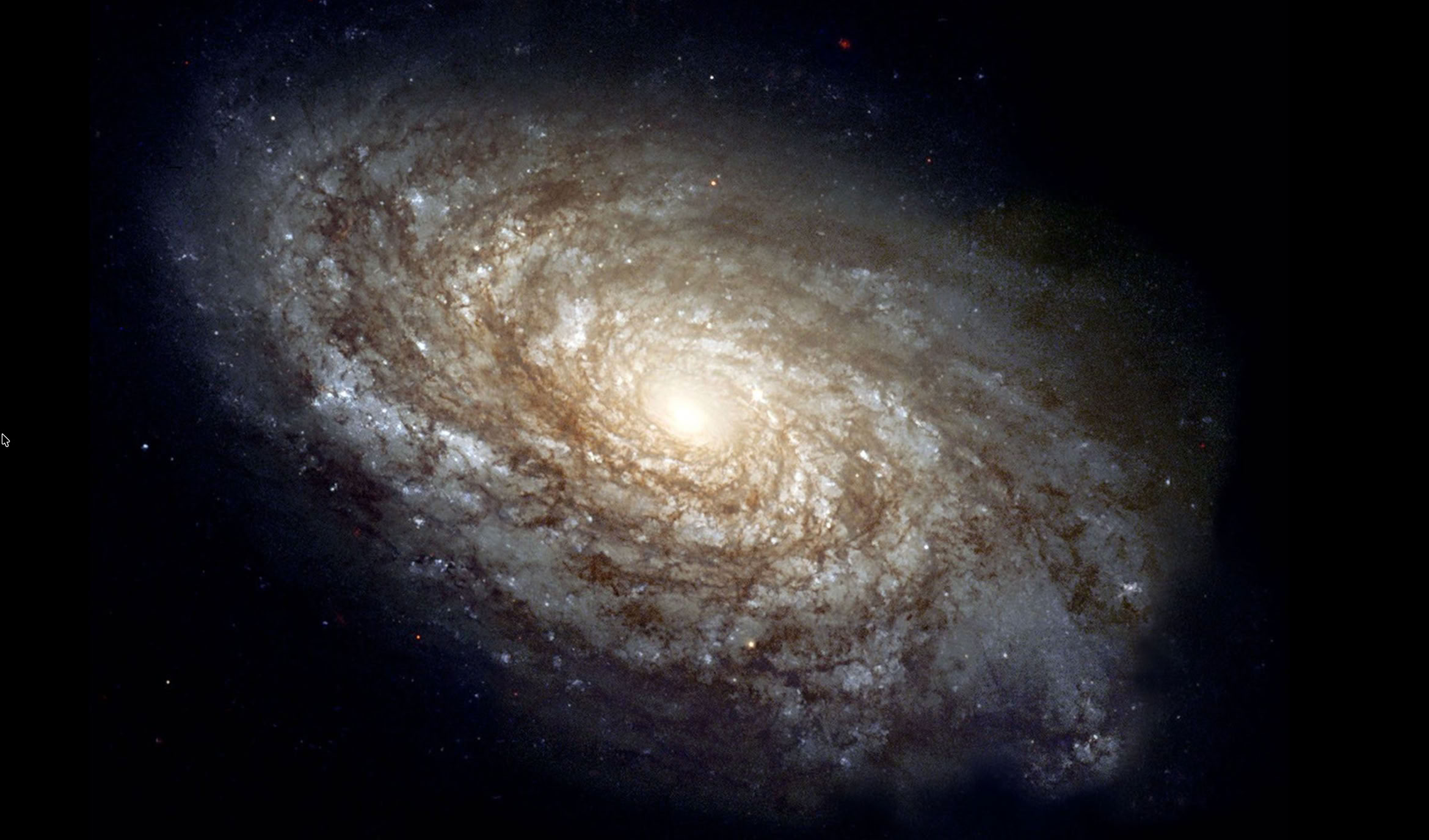
FIGURE 3.3 Hubble Space Telescope image of the dusty spiral galaxy NGC 4414. Image Source and Credit: NASA.
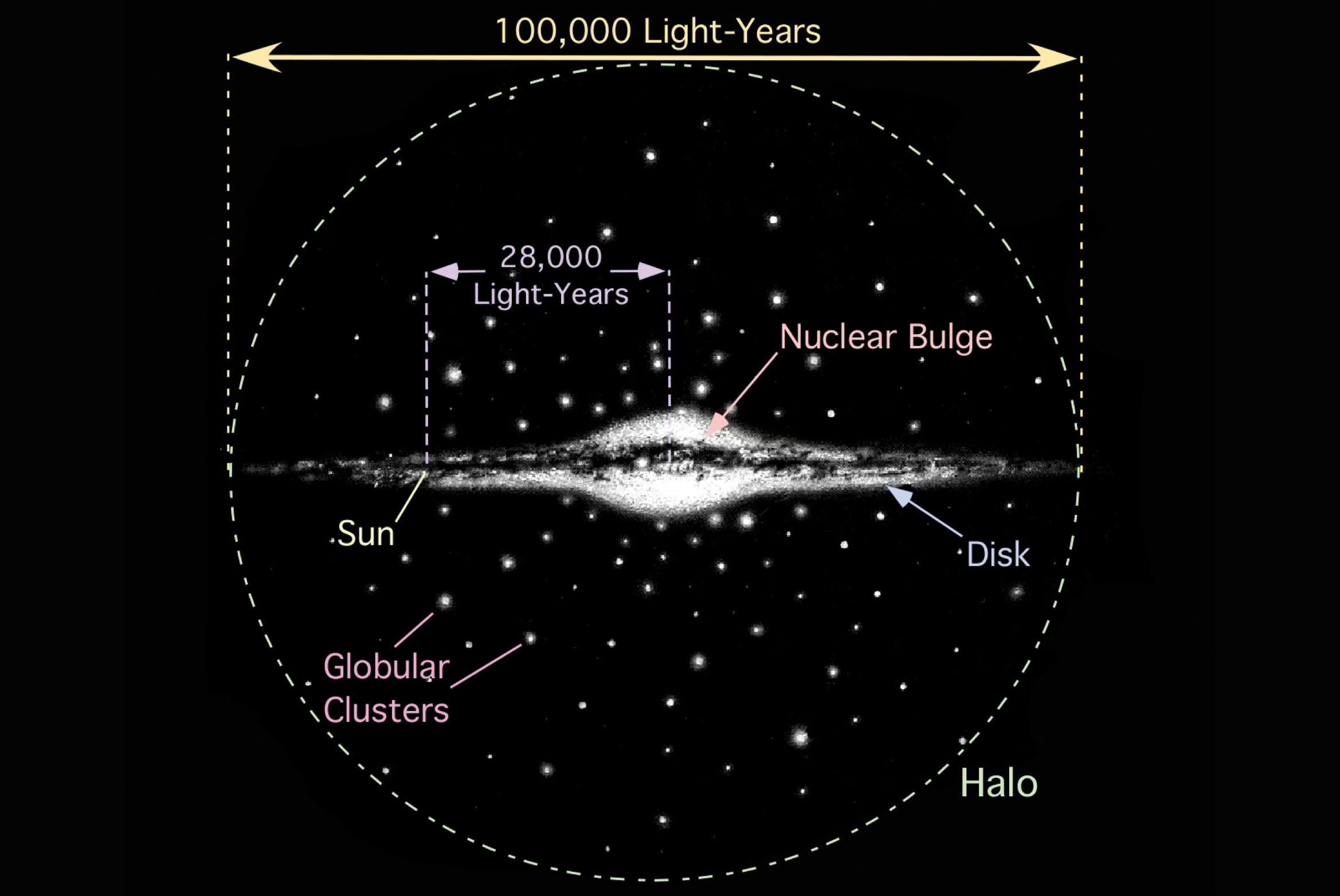
FIGURE 3.4 Typical features of a galaxy. The following image represents the Milky Way Galaxy (edge-on view). A typical galaxy has three main components: the disk, the nuclear bulge, and the halo. The disk is a rotating mass of young stars, gas, and dust, oriented in a flat plane. The nuclear bulge is found at the galaxy's center and contains a dense mixture of young and old stars. The halo is a large, somewhat spherical void with only a few scattered old stars and large clusters of stars known as globular clusters. The relative position of the Sun is also shown. Image Copyright: Michael Pidwirny.
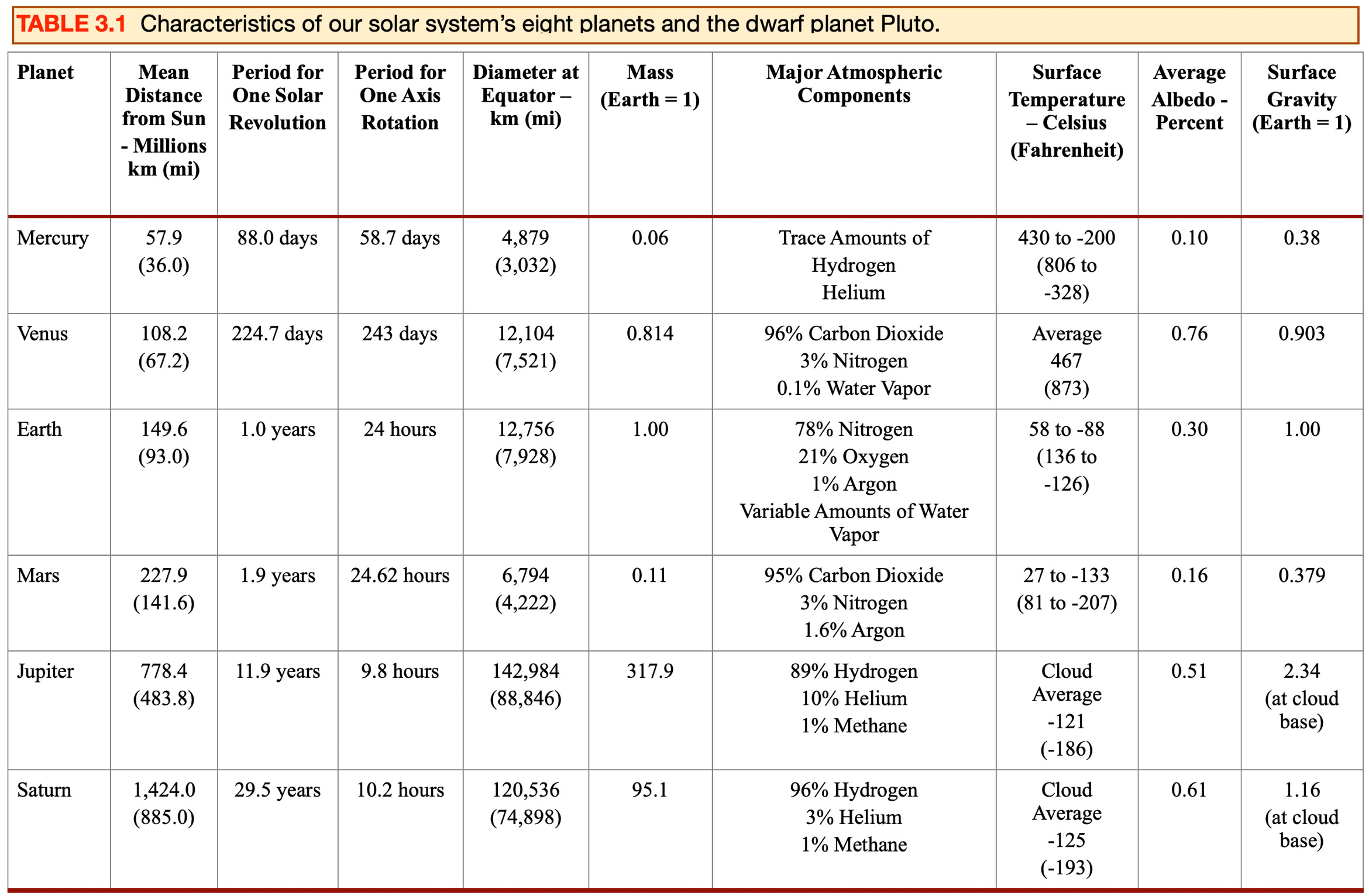
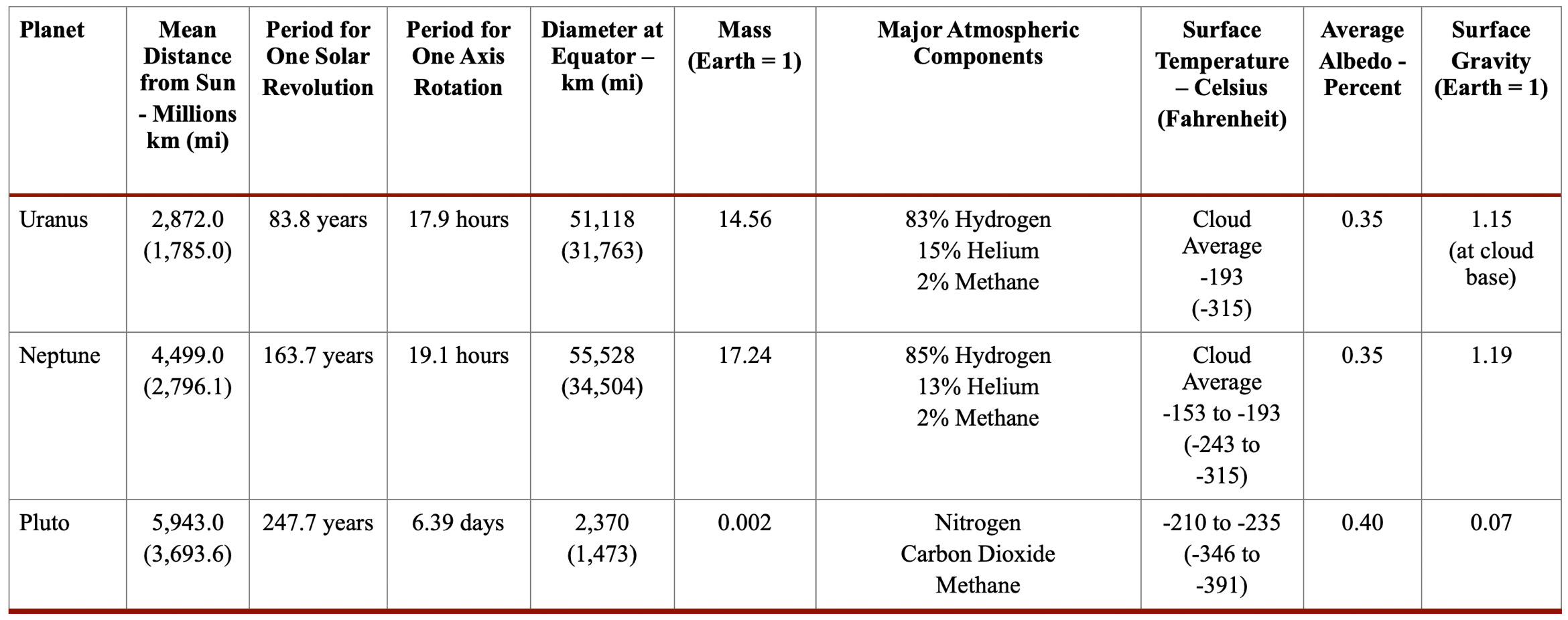

FIGURE 3.5 The inner solar system consists of the Sun, Mercury, Venus, Earth, and Mars. It is separated from the outer solar system (Jupiter, Saturn, Uranus, Neptune, and Pluto) by a dense asteroid belt between the orbits of Mars and Jupiter. Image Copyright: Michael Pidwirny.

FIGURE 3.6 Color-enhanced image of the planet Mercury taken by the Messenger satellite’s Wide Angle Camera on January 14, 2008. Note how the surface of Mercury has numerous surface craters and resembles Earth’s moon. Image Source: NASA.

FIGURE 3.7 Radar image of the surface of Venus from the 1990-1994 Magellan mission. Radar penetrated the thick clouds that normally obscure the planet's surface. The Magellan spacecraft imaged more than 98% of Venus at a resolution of about 100 meters (300 ft). Image Source: NASA.

FIGURE 3.8 Mars, the fourth planet from the Sun. The Hubble Space Telescope captured these two dramatically different images of our planetary neighbor, Mars. These images show how a global-scale dust storm engulfed Mars as the Martian spring began in the Southern Hemisphere. When NASA's Hubble Space Telescope imaged Mars in June, two small storms were seen in the giant Hellas Basin and at the northern polar cap. When Hubble photographed the planet again in early September, the storms had already been raging across the planet for nearly two months, obscuring all surface features with a thick layer of dust. This is the largest dust storm seen in several decades of observing Mars. Image Source: Hubble Space Telescope.
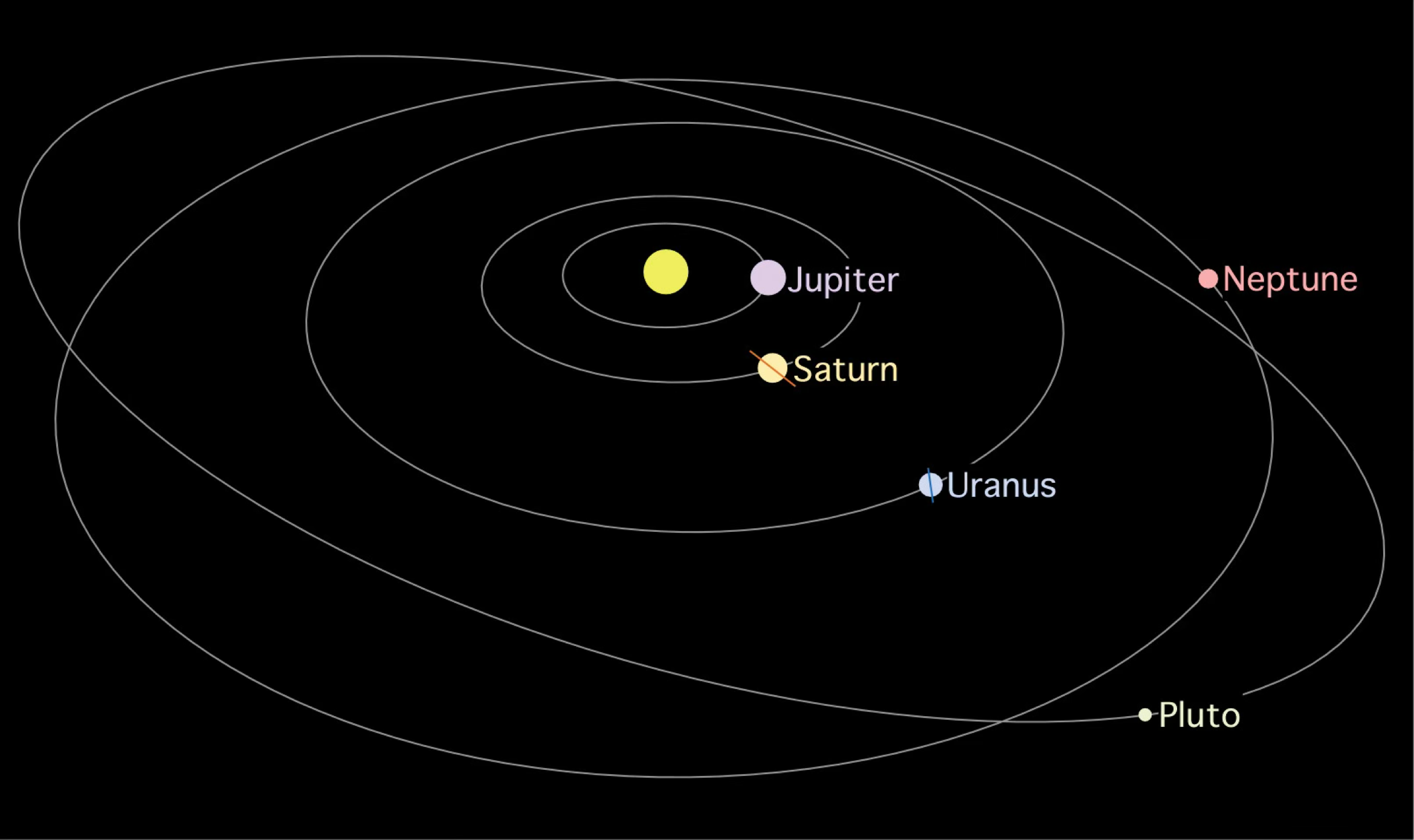
FIGURE 3.9 The outer solar system consists of the dwarf planet Pluto and the planets Jupiter, Saturn, Uranus, and Neptune. Image Copyright: Michael Pidwirny.

FIGURE 3.10 Hubble Space Telescope image of Jupiter taken on April 21, 2014 using the Wide Field Camera 3. In this image, the atmospheric storm known as the Great Red Spot is visible just below the center and to the right of the planet. Image Source: NASA.

FIGURE 3.11 Saturn as observed during October 1998. Saturn's equator is tilted by 27 ° relative to its orbit, which is very similar to the 23.5° tilt of the Earth. This image shows Saturn during its winter solstice, when its North Pole is tilted away from the Sun. Image Source: Hubble Space Telescope.

FIGURE 3.12 These two pictures of Uranus, one in true color (left) and the other in false color, were taken by Voyager 2 on January 17, 1986. The false-color image of Uranus reveals a dark polar zone surrounded by a series of progressively lighter concentric bands. One possible explanation for this pattern is that a brownish haze or smog, concentrated over the pole, is arranged into bands by the zonal flow of upper air winds. Image Source: NASA.

FIGURE 3.13 This image of Neptune was taken by Voyager 2. In the center of the image, we can see Neptune’s Great Dark Spot and its companion bright smudge. Image Source: NASA.
