What is Science?
Science is simply a way of acquiring knowledge about nature and the Universe. To practice science, one must follow a specific universal methodology. The central theme of this methodology is hypothesis testing. A hypothesis can be defined as a proposal intended to explain particular facts or observations that have not been formally tested. The overall goal of science is to better comprehend the world around us. Various fields of study, such as physics, chemistry, biology, medicine, and the earth sciences, have used science exclusively to expand their knowledge bases. Science allows its practitioners to acquire knowledge through neutral, unbiased techniques.
The broadest, most inclusive goal of science is to understand (Figure 1). Understanding involves two interconnected processes: explanation and confirmation. Explanation is perhaps the most important fundamental goal of understanding. Explanation consists of explaining reality with hypotheses, theories, and laws. An explanation may also relate observed phenomena to a system of empirical formulas or link them to hierarchically structured mechanisms at higher and lower levels of function. A theory can be defined as a collection of logical ideas that are used to explain something. The process of testing, refining, and retesting hypotheses constructs theories. The nature of this confirmation process suggests that theories are rarely static.
The explanation process has two important facilitating tools: idealization and unification (Figure 2). Idealization condenses a body of empirical facts into a simple statement. In condensation, some detail must be omitted, and the processes and phenomena must be more simply abstracted. Idealization may also involve isolating particular phenomena from other aspects of the system of interest. For example, models of the human heart often ignore the fact that it is one of many organs operating in tandem in our body. A second aspect of explanation is the unification of apparently unrelated phenomena under the same abstract or ideal system of concepts.
Another minor goal of science is the confirmation of constructed models of understanding (also called theoretical model building). Confirmation is accomplished by hypothesis testing, prediction, and experimentation. These essential tools of science will be discussed in detail in the next section.
The Hypothetico-Deductive Method
Francis Bacon (1561-1626), a 17th-century English philosopher, was the first to suggest a universal scientific methodology. Bacon believed that the scientific method requires an inductive process of inquiry. Induction involves the formulation of a theory after the analysis of gathered facts. In the 20th century, philosopher Karl Popper argued that it is impossible to prove a scientific theory true by induction because no amount of evidence guarantees that contrary evidence will not be found. Instead, Popper proposed that deductive logic is the best way to do science. Deduction involves stating a hypothesis first and examining reality to find evidence to disprove the proposed idea. Popper termed the procedure of trying to disprove a proposed hypothesis falsification.
Researchers in Earth Science usually test hypotheses through prediction or experimentation. A prediction is a forecast or extrapolation from the current state of the phenomenon of interest. Predictions are most helpful if they can go beyond simple forecasts. Predictions can be made through computer models that employ a network of mathematical relationships that describe how the phenomenon works under different scenarios. Computer models that evaluate the climatic effects of human modification of the Earth’s atmosphere work this way. An experiment is a controlled investigation designed to assess the outcomes of causal manipulations on some system of interest.
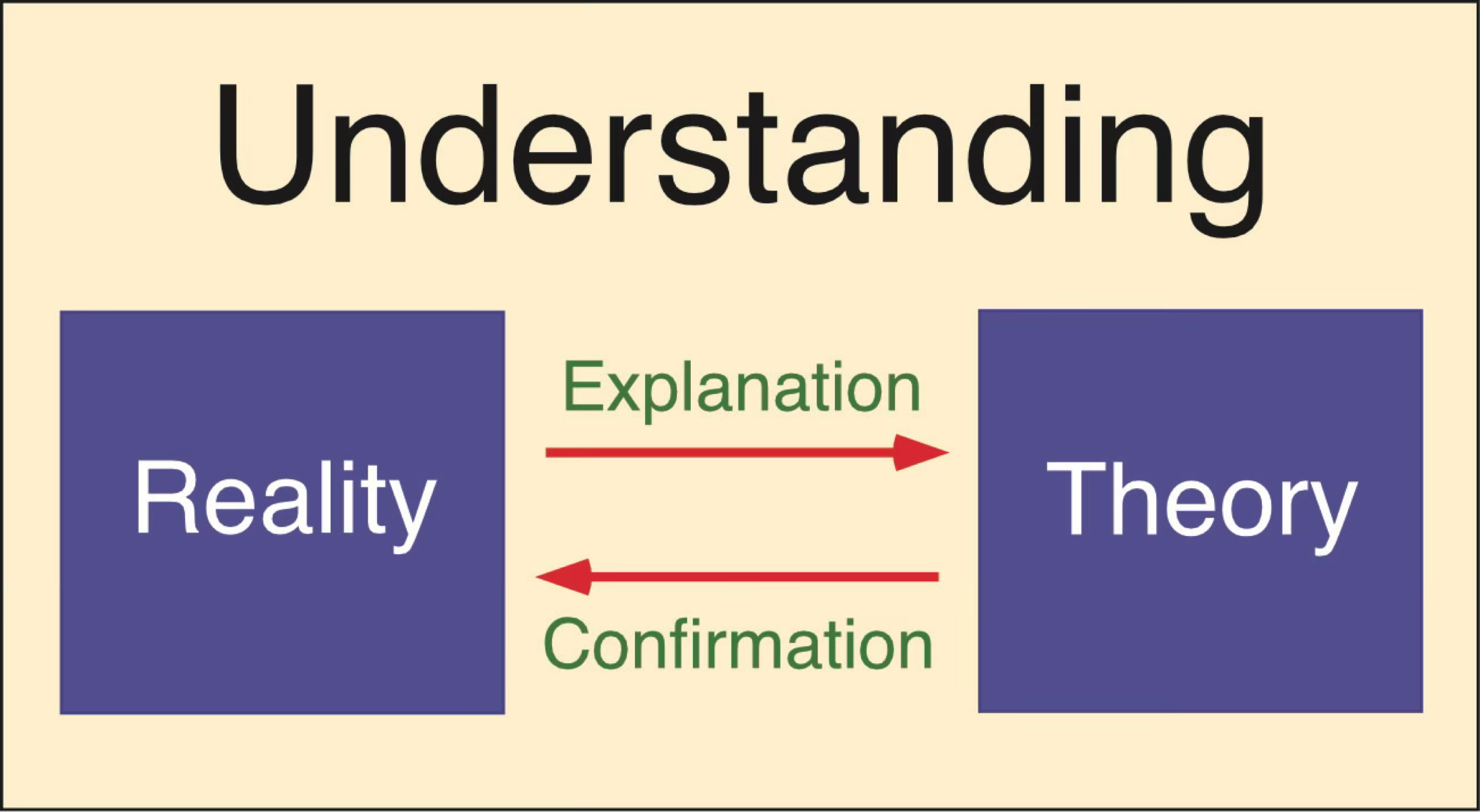
FIGURE 1 Relationship between reality, theory, and understanding in science. This model suggests that we develop scientific theories to explain phenomena found in the real world. Once a theory is established, it must be confirmed by re-examining reality to find contrary data. If contrary data is found, the theory is modified to include this new information, and the confirmation process begins again. The process of validating theories is continuous because we can never assume that we have considered all possibilities available. Image Copyright: Michael Pidwirny.

FIGURE 2 Facilitating tools involved in explanation and confirmation. Image Copyright: Michael Pidwirny.