FIGURE 4.1 Some of the various types of electromagnetic radiation as defined by wavelength. This representation of the electromagnetic spectrum extends from very long radio waves to extremely short gamma rays. Visible light has a wavelength range of 0.40 to 0.71 micrometers (µm). Image Copyright: Michael Pidwirny.
FIGURE 4.4 Components of visible light. Visible light is composed of six identifiable color bands. The average wavelength of each of these bands is shown on the right. This illustration also indicates that the terms shortwave and longwave can be applied to the bands to describe their wavelengths relative to one another. Image Copyright: Michael Pidwirny.
The Sun provides the Earth with most of the energy needed to power the various systems on our planet. This energy is in the form of electromagnetic radiation or radiant energy. This type of energy can travel through the voids of space. When sunlight reaches Earth, it is converted into heat energy or used by plants for photosynthesis. At this point in this eBook, we must learn more about electromagnetic radiation. This additional knowledge will play an essential role in helping us understand how our planet's various abiotic and biotic systems are powered.
Waves and Photons
All objects above the temperature of absolute zero (-273.15°C or -459.67°F) emit energy as electromagnetic waves into their surroundings. This radiation is emitted from these bodies and travels at the speed of light in all directions away from the object. We see this phenomenon every time a light bulb is switched on. Many different types of radiation have been identified (Figure 4.1). Each of them can be defined by a physical characteristic known as wavelength.
English physicist Thomas Young first demonstrated that radiation has wavelike characteristics in 1801. This idea arose from an experiment in which light passed through an opaque screen with two parallel slits. On a white surface some distance away from the slits, Young noticed two bright light bars corresponding to the opaque screen's openings. He also saw a pattern of alternating bright and dark bands on either side of the bright bars. These other patterns suggested that the two beams of light from the slits were refracting away from each other. Young concluded that this interference must be due to the fact that light travels as a wave (Figure 4.2).
A wavelength can be defined as the distance from a specified position on one wave to the exact location on the next successive wave (Figure 4.3). The wavelength of electromagnetic radiation can vary from being infinitely short to infinitely long (Figure 4.1). The wavelength of the Sun's radiation spans a range or spectrum from about 0.1 to 4.0 µm (micrometers). The wavelength of visible light is between 0.40 and 0.71 µm, and the Sun emits only a portion (44%) of its radiation in this smaller zone. Figure 4.4 describes the various spectral color bands that make up visible light. The wavelength band from 0.1 to 0.4 µm is called ultraviolet radiation. About 7% of the Sun's emission falls within this wavelength range. About 48% of the Sun's radiation falls within the 0.71-4.0 µm range. This band is calledinfrared radiation. Scientists have divided the infrared spectrum into two sub-bands: near-infrared (0.71 to 1.5 µm) and far-infrared (1.5 to 4.0 µm).
Other experiments on electromagnetic radiation suggested that this form of energy may also behave like a stream of subatomic particles. These tiny packets of energy are called photons. Photons are quite different from particles of matter. They have no mass, take up no space, and always travel at the speed of light. Photons are similar to matter in one important characteristic; they can be charged with energy. The amount of energy stored in a photon varies inversely with wavelength; in other words, shorter wavelengths have more energy than longer wavelengths.
Emission and Absorption
Radiation is created from the conversion of other forms of energy. This conversion occurs within the atomic structure of matter, where excited electrons emit and absorb radiation (photons). Matter typically creates radiation from the internal heat energy of atomic motion. Once created, most of the radiation then travels out of the mass into the surrounding environment (some is trapped when it strikes the object’s other atoms). This process is called emission, and it occurs as long as an object has a temperature above absolute zero. Radiation emission also causes a net loss of heat energy from an object over time. Thus, objects will experience a drop in temperature if there is a net radiation loss from their surface.
We can better understand how radiation emission works by looking at a familiar process. This process is the generation of light by a light bulb. Light is produced in light bulbs by passing electrical energy through a tungsten filament at the center of a glass bulb. This electrical current generates heat in the filament's atoms. At this higher energy state, the electrically produced heat energy causes electrons in the filament’s atoms to become excited with additional energy (Figure 4.5). Electrons in any substance can have different energy levels. An increase in atomic energy usually causes an electron to temporarily move into an orbit farther away from the nucleus. The electron maintains this new orbit for only a fraction of a second. The electron then converts the extra atomic energy into a photon, causing it to drop back to its standard orbit. This photon then leaves the filament and travels out of the bulb at the speed of light. The process of photon formation in the light bulb repeats itself over and over again as long as electricity is supplied to the filament. Turn off the electricity, and the creation of light stops.
The amount of radiation emitted by an object depends on its temperature. Objects at higher temperatures emit more radiation than cooler ones. To emit visible light, the filaments in light bulbs must reach about 2200°C (4000°F). The association between temperature and the quantity of emission is essentially constant for all bodies in the Universe. Because of this consistency, this relationship can be described with a simple equation. The Stefan-Boltzmann Law describes this relationship mathematically for a special type of radiating object known as a blackbody. Simply put, a blackbody is an object that emits the maximum amount of radiation possible for a given temperature. In reality, no substance found in the Universe is a perfect emitter of radiation. Many solids, liquids, and dense gases tend to radiate close to the blackbody rate. The equation for the Stefan-Boltzmann Law is as follows:
where σ (Greek letter sigma) is a constant value equal to 5.67 x 10⁻⁸ Wm-2 K4 and T is temperature measured in Kelvin units.
According to the Stefan-Boltzmann Law, a proportional increase in temperature leads to an exponential rise in radiation output. This fact is evident in Table 4.1. According to the table, the amount of radiation produced per 100°C increase in temperature from -200 to 500°C is not the same. It becomes exponentially larger with each 100°C step. We can also use this law to calculate the radiative output for the Earth and the Sun. With an average surface temperature of 288 K (15°C or 59°F), the Earth is predicted to emit about 390 Wm-2 (watts per square meter). The Sun's temperature is about 5800 K (5527°C or 9981°F). At this temperature, the radiation emitted will be approximately 64,000,000 Wm-2. The Sun's radiation output is 160,000 times greater than Earth's. If a body has a temperature of 0 K (-273.15°C or -459.67°F), absolute zero, the law predicts that radiation emission will be zero. In Chapter 3, the third law of thermodynamics suggests that atomic motion would stop at this same temperature. The connection between these two phenomena is quite simple. Radiation can only be created if kinetic energy exists in an atom.
The temperature of an object also influences the quality of radiation it emits. Figure 6 describes the radiation curves (spectrums) for the Earth and the Sun, which have average surface temperatures of 15°C (288 K or 59°F) and 5527°C (5800 K or 9981°F), respectively. From the curves, we can see that these two bodies emit radiation in different wavelength bands. Most of the Earth’s radiation is centered at a wavelength of about 10 µm (micrometers). The much hotter Sun emits most of its radiation at a lower wavelength of about 0.5 µm. Once again, the relationship shown here can be defined mathematically. This mathematical relationship is known as Wien’s Law. Wien’s Law calculates the wavelength of maximum emission for a radiating body. The formula for this law is:
Table 4.2 lists the wavelengths of maximum emission for objects at various temperatures. The data in this table suggest that increasing the temperature of the radiating body decreases the wavelength of maximum emission.
Matter can also absorb radiation. The absorption process is, in many ways, the opposite of emission (Figure 4.7). An atom's absorption of a photon causes one of its electrons to become excited because of energy transfer. The electron jumps to an orbital further away from the atom's nucleus for a short period. After this brief period, it returns to its normal orbit, and the energy transferred to the electron is converted into heat energy. This heat energy then increases the atom's kinetic motion.
A mutual relationship exists between a substance's ability to absorb and emit radiation. As a result, near blackbody emitters of radiation tend to be good absorbers of the same wavelengths. Some substances exhibit an interesting characteristic: they emit and absorb specific, discrete wavelength bands. Such substances are called selective emitters and selective absorbers of radiation. Some gases in the planet's atmosphere exhibit this property (Figure 4.8). For example, methane (CH4) is a selective absorber and emitter of radiation in two narrow bands centered at 3 and 7 µm.

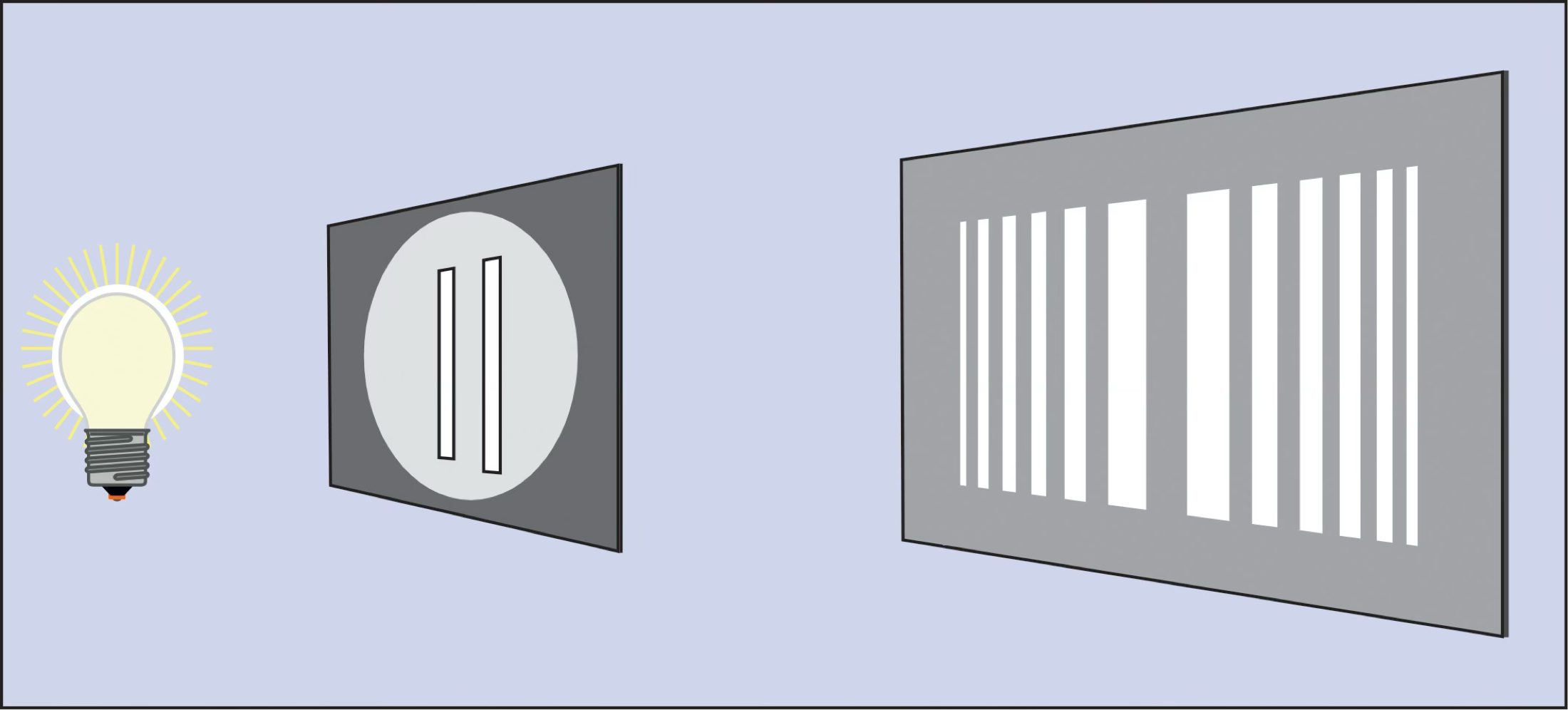
FIGURE 4.2 Thomas Young’s 1801 light wave experiment projected light through two open slits on an opaque screen. The projection behind the screen consisted of more than two beams of light. The extra bars of light indicated that the two beams of light were interfering with each other beyond the opaque screen. This interference occurred because the light rays were moving side to side in a wavelike fashion. The side-to-side travel causes the beams of light to occasionally overlap, refracting some of the light in a slightly altered direction. The other light bars found on either side of the original beams were created by the altered rays of light. Image Copyright: Michael Pidwirny.

FIGURE 4.3 Concept of wavelength measurement. The distance from the top of a wave crest to the next is equal to one wavelength. Image Copyright: Michael Pidwirny.


FIGURE 4.5 Photon emission process. Photons can be produced by the addition of heat energy to an atom. Before the heat is added, the atom’s electrons travel normally in their orbits (A). The addition of heat can cause an electron to gain enough energy that it momentarily jumps into a higher orbit (B). The excited electron then quickly converts the additional energy it gained into a photon (C). The creation and release of the photon causes the electron to return to its normal orbit around the nucleus. Note that heat is not the only type of energy that can create photons. Photons can also be produced by electricity, chemical energy, frictional heating, or nuclear decay. Image Copyright: Michael Pidwirny.



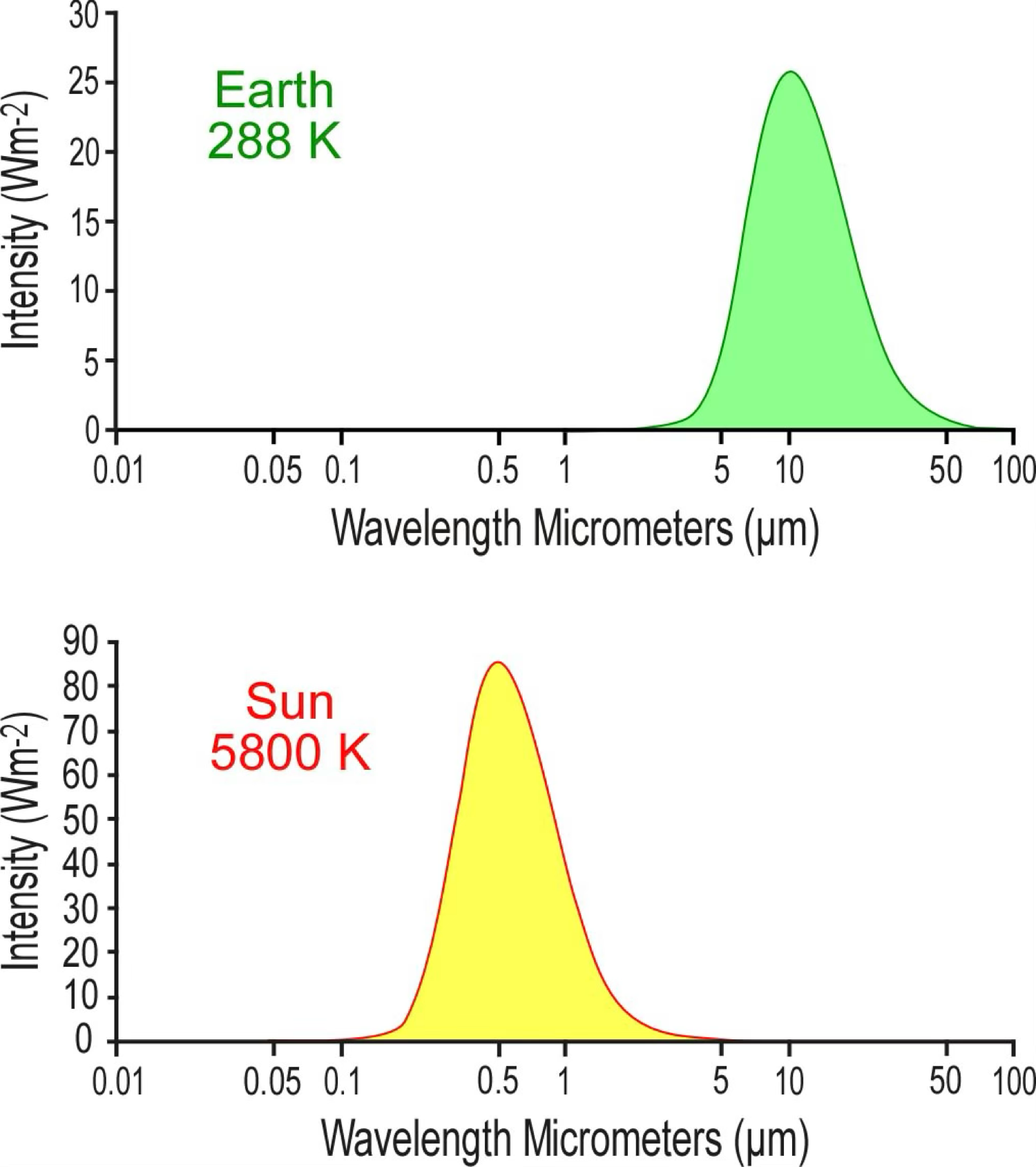
FIGURE 4.6 Radiation spectrums for the Earth and Sun. Output measurements are in watts per square meter for the Earth and millions of watts per square meter for the Sun. Image Copyright: Michael Pidwirny.


FIGURE 4.7 The photon absorption process - electrons orbiting an atom's nucleus can absorb photons (A). The absorption of a photon causes an electron to gain enough energy to briefly jump into a higher orbit (B). The excited electron then quickly converts the additional energy it gained into heat energy and returns to its usual orbit (C). This heat energy is then passed on to the rest of the atom. Image Copyright: Michael Pidwirny.
FIGURE 4.8 Percent radiation absorption and emission effectiveness for some common gases found in the Earth’s atmosphere. CH4 – methane, N2O – nitrous oxide, O2 – oxygen, O3 – ozone, CO2 – carbon dioxide, and H2O – water vapor. Image Copyright: Michael Pidwirny.