The Sun and the associated planets that orbit it formed between 5 and 4.6 billion years ago, as matter in our solar system coalesced because of gravity. By about 3.9 billion years ago, the Earth’s primitive oceans contained the right mix of simple organic molecules to begin the development of life. Scientists believe that energy from heat, lightning, or radioactive elements enabled the synthesis of simple organic molecules into more intricate proteins and nucleic acids. These proteins and nucleic acids are then further organized into more complex molecules known as protobionts. Protobionts maintained an internal chemical environment distinct from their surroundings and exhibited some of the properties we associate with living things on our planet today. Still, protobionts were not able to reproduce precisely.
The common ancestor of all life probably appeared on our planet about 3.8 billion years ago (Figure 11.10). This organism evolved from protobionts and could use RNA (ribonucleic acid) for accurate genetic replication. This ancestor then gave rise to the two new major lineages of life that would subsequently base their heredity on DNA (deoxyribonucleic acid) instead: the prokaryotes and eukaryotes (Figure 11.11). These organisms were more successful than their ancestors because DNA is a more secure repository of genetic information.
About 3.5 billion years ago, conditions became suitable for the fossilization of Earth's cellular life forms. These fossilized cells resemble present-day cyanobacteria and are prokaryotic. Prokaryotic cells are less complex than eukaryotic cells, containing few specialized cellular structures. Ancient prokaryotic organisms capable of photosynthesis appeared around 3.4 billion years ago. Because oxygen was lacking, these organisms probably used light to convert carbon dioxide (CO2) and hydrogen sulfide (H2S) into glucose. This process releases sulfur as a waste product. About a billion years later, when oxygen was more abundant, a second photosynthesis system developed, in which carbon dioxide (CO2) and water (H2O) were used to produce glucose. This system is predominant in today's photosynthetic life forms.
Eukaryotic cell types first appeared on our planet about 2.1 billion years ago (Figures 11.10 and 11.11). Modern-day ancestors of early eukaryotic organisms include protists, fungi, plants, and animals (Figure 11.11). By 680 million years ago, eukaryotic cells began organizing themselves into more complex multicelled creatures. Animals appeared before the Cambrian, about 600 million years ago. Fossils of these ancient creatures were found in rocks near Adelaide, Australia. It is still undecided if these forms have any surviving descendants. Some fossilized organisms from this time look like jellyfish and sea anemones, while others resemble earthworms.
About 542 million years ago, an enormous diversification of multicellular life occurred, known as theCambrian Explosion. Higher oxygen concentrations in our planet's oceans may have triggered this evolutionary event. Such a condition would have permitted larger organisms with higher metabolisms to evolve. Or the Cambrian Explosion may have been caused by an increased presence of shallow seas at that time. Shallow seas provide organisms with a greater variety of habitats, higher nutrient concentrations, and more favorable temperatures for survival. During the Cambrian, all but one modern major category (phylum) of animal life made its first appearance on the Earth (Figure 11.12). Some scientists believe there may have been more animal phyla (plural of phylum) during the Cambrian than there are now. A second explosion of species diversity occurred around 500 million years ago. During this event, many different types of life, including ancient fish and corals, first appeared on Earth. By about 440 million years ago, most of the creatures introduced during the Cambrian Explosion had declined. More complex plant types evolved from simple green algae around 400 million years ago. These first land plants resembled mosses and required moist environments to survive. The subsequent development of a waxy protective layer over exterior tissues allowed some plants to exploit drier inland habitats. At about the same time, the first animals, related to modern centipedes and millipedes, followed plants onto the Earth’s terrestrial surface.
Animals with backbones (vertebrates) moved onto the land surface about 380 million years ago. The amphibianIchthyostegais the first known land vertebrate. Fossils of this organism were found in Greenland, indicating that this landmass once had a much warmer climate. Amphibians gave rise to reptiles approximately 320 million years ago. Reptiles differentiated from amphibians by evolving two necessary adaptations: Scales to decrease water loss and a shelled egg. Both of these traits enable successful invasion into drier habitats.
About 250 million years ago, the Permian-Triassic Extinction occurred, and researchers estimate that 96% of all species became extinct at this time. Because of this event, the last of the Cambrian fauna disappeared from our planet. Following the Permian extinction, the Modern fauna that evolved after the Cambrian explosion rose quickly in dominance. The Modern fauna includes fish, bivalves, gastropods, and crabs. The Permian extinction also changed the vegetated landscape of our planet. Before this event, the dominant land plants were ferns and horsetails. After this event, gymnosperms (pines, spruce, fir, larch, junipers, redwoods, and cedars) became much more abundant and widespread. Gymnosperms differed from their fern ancestors in that they possessed true seeds. This adaptation allowed gymnosperms to disperse into new environments quickly.
Flowering plants or angiosperms evolved from gymnosperms about 140 million years ago (Figure 11.13). Two necessary adaptations allowed angiosperms to succeed gymnosperms as the prevailing flora: Fruits and flowers. Fruits allowed for animal-based seed dispersal. It also supplied the establishing seedling with a supply of fertilizer after the seed passed through the animal’s digestive system. Flowers evolved to enable animal, mainly insect-based, pollen dispersal (Figure 11.14). The development of fruits and flowers made angiosperms the dominant form of vegetation on the Earth.
The end of the Cretaceous, roughly 65 million years ago, is marked by another mass extinction. This extinction targeted all dinosaur families except birds. Up to this time, mammals played only a minor role in the fauna of our planet. This situation occurred even though they first evolved from reptiles about 210 million years ago. These early mammals were small, insectivorous, and nocturnal. With the demise of the dinosaurs, mammals began to diversify rapidly, and evolution produced a variety of creatures that could occupy a wide range of habitats (Figure 11.15). One of the most successful mammalian families is the primates from which we have descended.

FIGURE 11.10 Important events in the evolution of life. Dates for many of the events shown are based on fossil evidence. Image Copyright: Michael Pidwirny.

FIGURE 2 Timing of the evolution of the six major lineages of life. The scale on the left shows the approximate time when each of these major types of life came into existence. Image Copyright: Michael Pidwirny.
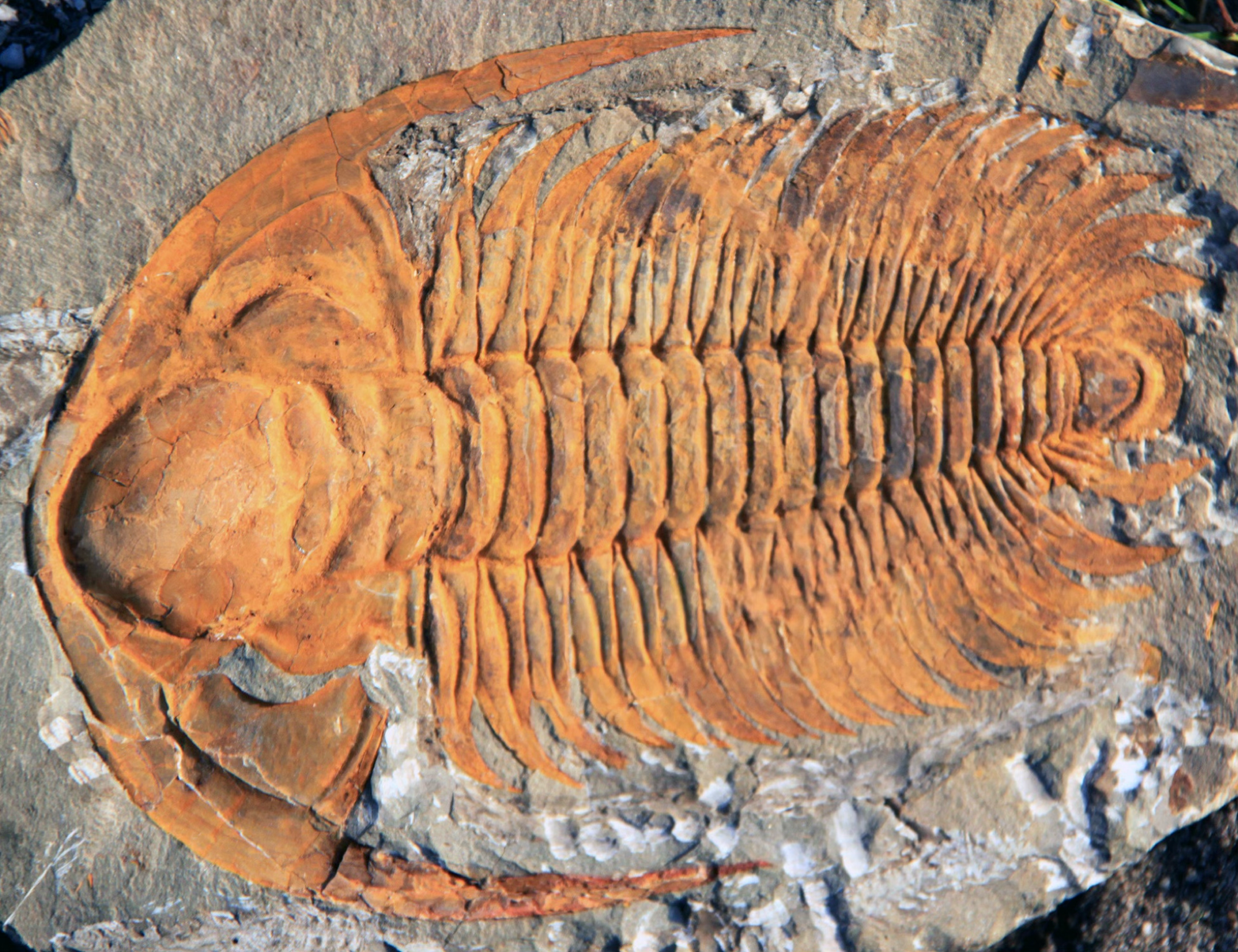
FIGURE 11.12 The Cambrian Explosion is perhaps the most striking evolutionary event documented in the fossil record. During this event, all but one of the modern major categories of animal life first appeared. One organism that became common as a result of this event is the trilobite. Trilobites are hard-shelled arthropods that lived in the Earth’s ancient ocean. Shown is a fossil of an extinct trilobite species, Paradoxides sp., from the Cambrian period. Image Source: Wikimedia Commons. This image is licensed under the Creative Commons Attribution-Share Alike 3.0 Unported license.

FIGURE 11.13 Angiosperms are plants that form seeds inside a protective structure called an ovary. Ovaries are part of a much larger reproductive structure called a flower. Many angiosperm species use colorful flowers to attract pollinators. Flowering plants are the most diverse and geographically widespread of all plant types. Over 250,000 different species of angiosperms have been classified. Image Copyright: Michael Pidwirny.

FIGURE 11.14 The evolution of insects is closely tied to the development of flowering plants. Many insect species have close relationships with flowering plants. Flowering plants often use insects for pollination in exchange for some food in the form of nectar and pollen. Image Copyright: Michael Pidwirny.

FIGURE 9 Through evolution, animals have been able to gain adaptations that allow them to thrive in a variety of habitats. One can find mammals surviving in the cold Arctic habitats to the hottest deserts. Mammals have persisted across all climate types because they can maintain a constant body temperature. In cold climates, mammals succeed by having fur, thick layers of insulating fat, and the ability to burn stored energy from food to generate metabolic heat. To help them survive in hot climates, mammals have sweat glands that remove heat from the skin by evaporating water. Many desert mammals also use behavioral adaptations to keep themselves cool. They are active mainly at night and rest in cool burrows during the day. Image Source: Wikimedia Commons, Top Photo by Ansgar Walk, Licensed Under CC BY-SA 2.5, and Bottom Photo by Baiken, Licensed Under CC BY-SA 3.0.