Scientists simply define energy as the capacity to do work. Albert Einstein suggested in the early 20th century that energy and matter are related to each other at the atomic level. Einstein theorized that it should be possible to convert matter into energy. From Einstein's theories, scientists were able to harness the energy of matter beginning in the 1940s through nuclear fission. Nuclear fission releases vast amounts of heat energy by breaking the atomic bonds between atoms. The most spectacular example of this process is the nuclear explosion produced by an atomic bomb. A more peaceful example of our use of this fact of nature is the production of electricity from controlled fission reactions in nuclear reactors.
Einstein also suggested that it should be possible to transform energy into matter. In 1997, researchers at Stanford University's Linear Accelerator Center successfully converted energy into matter (Burke et al., 1997). This feat was accomplished using lasers and incredibly strong electromagnetic fields to change ordinary light into matter.
Energy and matter are also associated with each other at much larger scales of nature. Later in this chapter, we will examine how solar radiation provides the energy to create the matter that makes up organisms. Organisms use some of this matter to power their metabolism.
Types of Energy
Energy comes in many forms. The simplest definition of energy types suggests that there are two forms: kinetic and potential. Kinetic energy is the energy due to motion. A rock falling from a cliff, a bee in flight, the blowing leaves of trees, and water falling over a waterfall are all examples of kinetic energy. Potential energy is the energy stored by an object that can be potentially transformed into another form of energy. Water stored behind a dam, the chemical energy of the food we consume, and the gasoline we put in our cars are all potential energy. Conversion of this energy occurs when an organism uses food to energize its metabolism, when water in a dam flows through turbines to produce electricity from water in motion, or when gasoline is used in an engine to produce motion from chemical combustion.
Some other forms of energy include heat, electricity, sound, chemical reactions, magnetic attraction, atomic reactions, and light. Basic definitions for a few of these types of energy are as follows:
- Electromagnetic Radiation or Radiation - is the emission of energy from a material object as electromagnetic waves and photons.
- Atomic Energy - is the energy released from an atomic nucleus because of a change in its subatomic mass.
- Heat Energy - is a form of energy created by the combined internal motion of atoms in a substance.
- Chemical Energy - is the energy consumed or produced through chemical reactions.
- Electrical Energy - is the energy produced from the force between two objects having the physical property of electrical charge.
On Earth, there are fundamentally three ways energy can be transferred from one place to another: conduction, convection, and radiation. Conduction is the transfer of heat energy directly from atom to atom along a temperature gradient. Conduction can operate in a gas, liquid, or solid. Convection is the transfer of heat energy by the vertical movement of a mass of gas or liquid (horizontal transfer is called advection). Radiation is the only means of energy transfer that can occur across the empty void of outer space. We will discuss these processes again in much greater detail at the end of this chapter.
Measurement of Energy
In the previous sections, we began developing an operational idea of energy. We now must learn how energy is measured and quantified using a standard set of units. Worldwide, two systems of units of measurement are often used today: the Metric System (Système International) and the British System. The units of energy described in these systems are derived from a technical definition of energy used by physicists. The following mathematical relationship can represent this definition of energy:
Similar to the definition given in the previous section, physicists view energy as the ability to do work. However, they define work as a force applied to some form of matter (object) multiplied by the distance that this object travels. Physicists commonly describe force with a unit of measurement known as a Newton (N). This unit of measurement is named after Sir Isaac Newton. A Newton equals the force needed to accelerate (move) a mass weighing one kilogram one meter in one second in a vacuum with no friction. The work (or energy) needed to move an object with the force of one Newton over a distance of one meter per second squared (the increase in speed that is attained with each additional second) is called a joule (J).
Two other energy measurement units that you will come across on this website are calories and watts. A calorie (cal) equals the amount of heat required to raise one gram of pure water from 14.5 to 15.5°C at standard atmospheric pressure. One calorie equals 4.1855 joules. A kilocalorie (kcal) is equal to 1000 calories.
A watt (W) is a metric unit of measurement of the intensity of radiation normally measured over a square meter of surface area (watts per meter squared or Wm-2). A watt differs from a calorie and a joule in that it measures power, or the rate of work. The following equation can define power:
One watt is equal to one joule of work done per second. A kilowatt (kW) equals 1000 watts.
Energy, Temperature, and Heat
So far, we have learned that energy can take on many forms. One important form of energy relative to life on Earth is kinetic energy. The amount of kinetic energy a body possesses depends on the speed of its motion and its mass. At the atomic scale, the kinetic energy of a body is determined by the heat energy stored in its atoms and molecules.
Kinetic energy is also related to the concept of temperature. Temperature is the measure of the average kinetic energy found in the atoms and molecules of a substance. The higher the temperature, the faster these particles of matter move. When the temperature is lowered, the atomic motion slows until it stops at -273.15°C (-459.67°F). This temperature is called absolute zero.
The difference between heat and temperature should become more evident in the following example. This example will also show a relationship between heat energy and mass. Let us compare the heating of two different water masses (Table 3.5). One mass weighs 5 g (grams), while the other is 25 g. If the temperature of both masses is raised from 20 to 25°C, the larger mass of water will require five times more heat energy for this increase in temperature. This large mass would also contain five times more stored heat energy.
Heat can also be defined as energy transferred from one object to another due to a temperature difference. The spatial distribution of temperature in a substance determines the direction and rate of heat flow. Heat always flows from warmer to colder areas. The rate or speed at which heat flows is controlled by the temperature gradient over space within a body composed of the same substance (Figure 3.20). Thus, the steeper the gradient, the more rapidly heat flows.
Several measurement scales have been created to quantify temperature. The Celsius, Fahrenheit, and Kelvin scales are the most commonly used. Swedish astronomer Anders Celsius developed the Celsius scale in 1742. On this scale, the melting point of ice is 0, the boiling point of water is 100, and absolute zero is -273. The Fahrenheit system is a temperature scale used exclusively in the United States. Created by German physicist Gabriel Fahrenheit in 1714, this scale assigns a value of 32 to the melting point of ice, 212 to the boiling point of water, and absolute zero to -460. In 1848, British physicist Lord Kelvin proposed the Kelvin scale. Scientists often use this system because its temperature scale begins at absolute zero and is proportional to the amount of heat energy in an object. The Kelvin scale assigns a value of 273 to the melting temperature of ice, while the boiling point of water is 373.
Some other important definitions related to energy, temperature, and heat are heat capacity, specific heat, sensible heat, and latent heat. The heat capacity is the amount of heat energy a substance absorbs per unit temperature increase. Specific heat is equivalent to the heat capacity of a unit mass of a substance or the heat needed to raise the temperature of one gram (g) of a substance 1°C (Table 3.6). Water requires about 4 to 5 times as much heat energy to raise its temperature as an equal mass of most types of solid matter. Sensible heat is heat that we can sense. A thermometer can be used to measure this form of heat. Latent heat is the energy needed to change a substance to a higher state of matter. This same energy is released from the substance when the change of state (or phase) is reversed. Figure 3.21 describes the various exchanges of latent heat involved with one gram of water.


FIGURE 3.20 The following diagram shows the temperature gradient in an object composed of a similar substance. At the extremes, red is hot, and blue is cold. The four arrows show the relative speed of the heat flow through this object to its edge. The short, wide arrow indicates a steep temperature gradient and relatively fast heat flow. The long, narrow arrow indicates a shallow temperature gradient and relatively slow heat flow. Image Copyright: Michael Pidwirny.

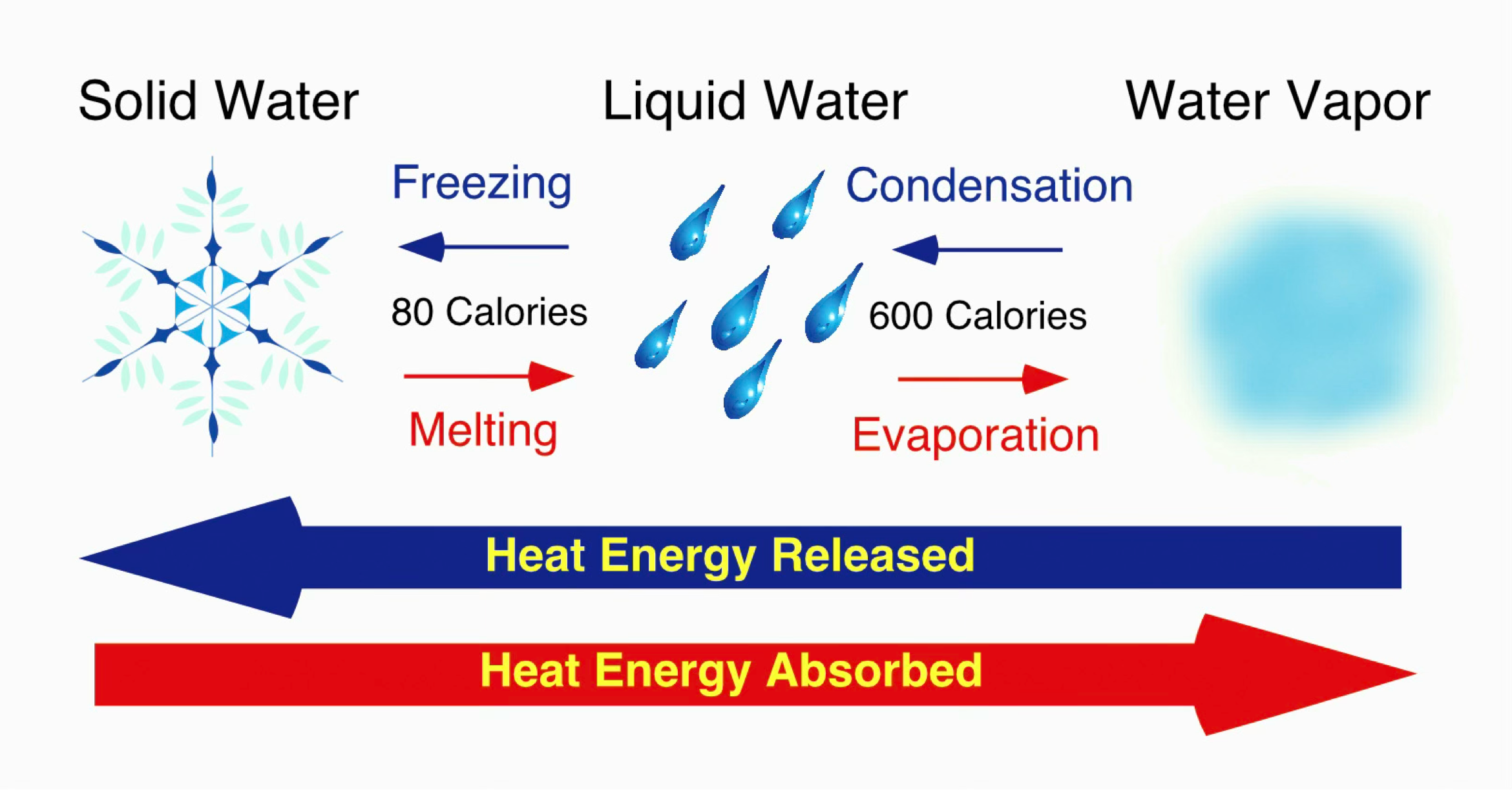
FIGURE 3.21 Latent heat exchanges of energy associated with the phase changes of 1 gram of water. Image Copyright: Michael Pidwirny.