The Atmosphere
Daily and Annual Cycles of Insolation
In the previous section, we learned that the Earth's seasons are controlled by changes in the duration and intensity of the Sun's electromagnetic radiation or insolation (incoming solar radiation). Both of these factors are governed by the annual change in the position of the Earth's axis relative to the Sun.
We have learned that annual changes in the Earth's axis cause the Sun to wander 47° across our skies. Changes in the Sun's location in the sky directly affect insolation intensity. The intensity of incoming solar radiation is primarily a function of the angle of incidence, the angle at which the Sun's rays strike the Earth's surface. If the Sun is directly overhead (90° from the horizon), insolation strikes the Earth's surface at right angles and is most intense. If the Sun is 45° above the horizon, the sunlight hits the Earth's surface at an angle. This situation spreads the rays over a larger surface area, thereby reducing the radiation intensity. Figure 4.25 shows the effect of changing the angle of incidence from 90 to 45°. As illustrated, the lower Sun angle (45°) causes the radiation to spread over a much larger surface area. This surface area is approximately 40% greater than the area covered by an angle of 90°. Accordingly, increasing the surface area receiving solar rays reduces the light intensity by 30%.
We can also model the effect the angle of incidence has on insolation intensity with the following simple equation:
Intensity = SIN (A)
where, A is the angle of incidence and SIN is the sine function found on most calculators. Using this equation, we can determine that an angle of 90° yields a maximum intensity of 1.00, or 100%. We can compare this maximum value with values determined for other angles of incidence shown in Table 4.4. Note that the values in this table are expressed as a percentage of the maximum value that occurs when the Sun is directly overhead.
The yearly changes in the position of the Earth's axis relative to the Sun also cause seasonal variations in day length at all locations outside of the equator. The longest days occur during the summer solstice for locations north of the equator and on the winter solstice for locations in the Southern Hemisphere. The equator experiences identical periods of day and night for every day of the year. Day and night are also of equal length for all Earth locations on the September and March equinoxes. Figure 4.26 describes the change in the day length for locations at the equator, 30, 50, 60, and 70° North over one year. The figure suggests that days are longer than nights in the Northern Hemisphere from the March equinox to the September equinox. Between the September equinox to March equinox, days are shorter than nights in the Northern Hemisphere. The opposite is true in the Southern Hemisphere. The figure also shows that the winter-to-summer variation in day length increases with increasing latitude. This phenomenon enhances the seasonal variation in insolation received for middle and high latitude locations.
Figure 4.27 (diagram A) describes the potential insolation (as measured outside the Earth's atmosphere) available for all locations on the Earth over one year. The values plotted on this graph consider the combined effects of angle of incidence, day length duration, and orbital distance changes between the Earth and the Sun. Locations at the Equator show the least amount of variation in insolation over one year (Figure 4.27 - diagram B). These slight changes in insolation result only from the annual changes in the altitude of the Sun above the horizon, as the duration of daylight at the Equator is always 12 hours (see Table 4.3, previous page). The peaks in insolation intensity correspond to the two equinoxes when the Sun is directly overhead. The two annual minimums of insolation at the Equator occur on the solstices when the Sun's maximum height above the horizon reaches an angle of 66.5°. However, note that the values of potential insolation received on these dates are different. Because of variations in the orbital distance between the Earth and the Sun, the Equator receives 420 Wm-2 on the December solstice and about 390 Wm-2 on the June solstice.
The most extreme variations in insolation received in the Northern Hemisphere occur at 90°N (Figure 4.27 - diagram C). During the June solstice, this location receives more potential incoming solar radiation than any other location graphed. At this time, the Sun never sets. It remains at an altitude of 23.5° above the horizon for the whole day. From September 22 (September equinox) to March 21 (March equinox), no insolation is received at 90° North. At this stage in the Sun's seasonal migration, it moves below the horizon because the Earth's northern axis is now tilted away from the Sun.
The annual insolation curve for locations at 50°N best approximates the seasonal changes in solar radiation intensity received in the mid-latitudes (Figure 4.27 – diagram D). Maximum insolation values are received at the June solstice when the day length and angle of incidence are at their maximum. During the June solstice, the day length is 18 hours and 27 minutes (see Table 4.3, previous page), and the angle of the Sun reaches a maximum height above the horizon of 63.5°. Minimum insolation values are received at the December solstice when day length and angle of incidence are at their minimum. During the December solstice, the day length is only 5 hours and 33 minutes, and the angle of the midday Sun only reaches a value of 16.5° above the horizon.
In Chapter 5, we will explore how atmospheric and surface factors modify these spatial and temporal variations in potential insolation.
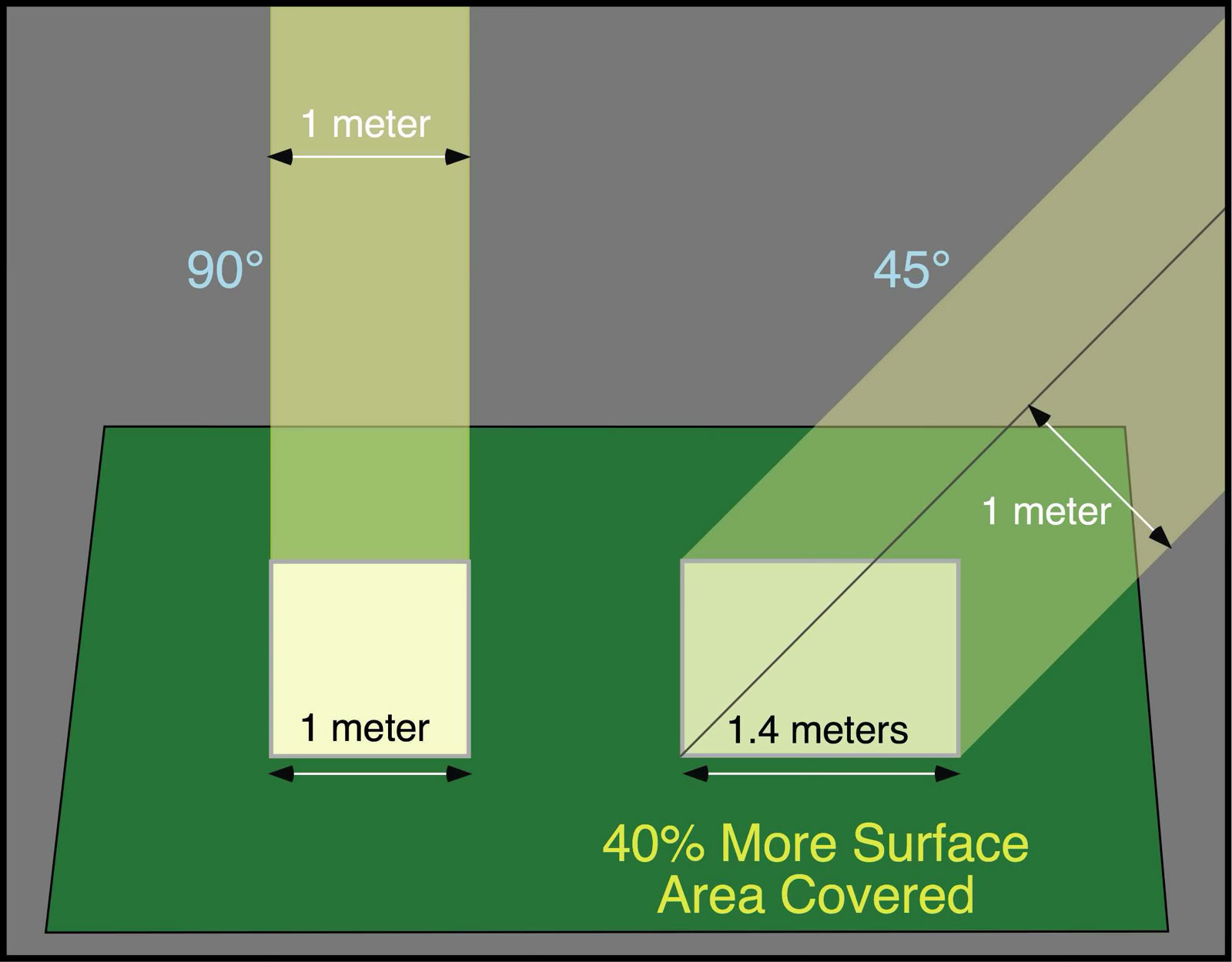
FIGURE 4.25 The Sun’s angle of incidence determines the intensity of the insolation received at the Earth’s surface. Solar radiation is most intense when the Sun is directly overhead (90°). Reducing the Sun’s altitude to 45° decreases the intensity of the insolation by 30% because the rays are now spread over a larger area. Image Copyright: Michael Pidwirny.


FIGURE 4.26 Annual variations in day length for locations at the equator, 30°, 50°, 60°, and 70° North latitude. Image Copyright: Michael Pidwirny.

FIGURE 4.27 Daily insolation at the top of the atmosphere in Wm-2. (A) Describes the availability of insolation by latitude and month. The dates for the equinoxes, June solstice, and December solstice are also shown. Pink zones indicate times and locations with no daily sunshine. Image Copyright: Michael Pidwirny.
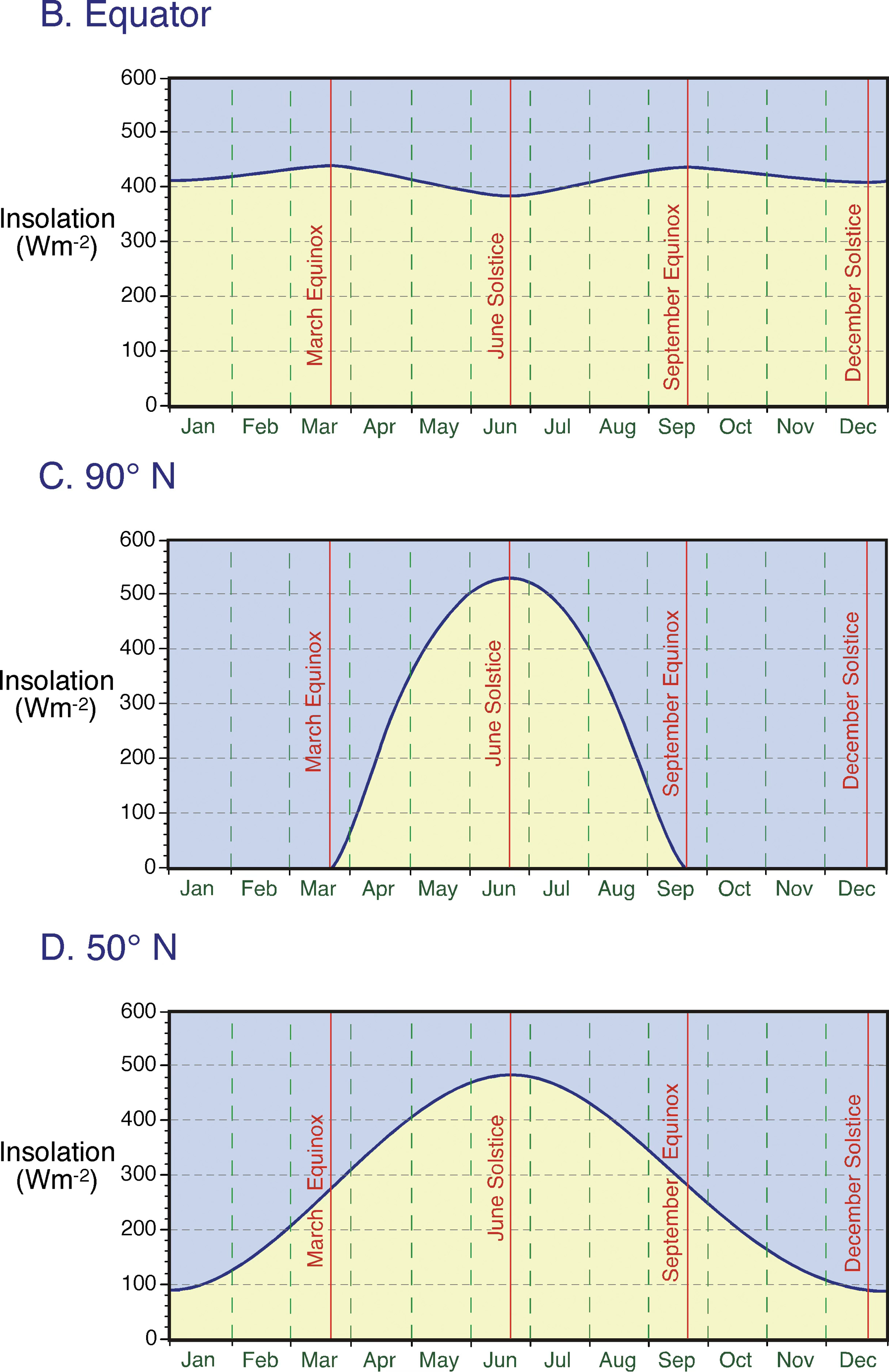
FIGURE 4.27 - Continued Daily insolation at the top of the atmosphere in Wm-2. (B) Shows the annual variation in daily insolation for the equator. At the equator, little annual variation in insolation occurs because of consistent 12-hour days and relatively high Sun angles all year long. (C) Describes the annual variations in daily insolation for 90°N. Note that this location experiences six months of darkness from the September equinox to the March equinox. (D) Portrays the annual variation in daily insolation for 50°N. Mid-latitude locations exhibit large seasonal variations in insolation, peaking at the June solstice. The lowest quantities of insolation are received during the December solstice. Image Copyright: Michael Pidwirny.